
Service 06
Zinc work, guttering and box gutters
A gutter hung to a string line and a gutter hung by eye look identical the day they go up. They stop looking identical around the third winter.
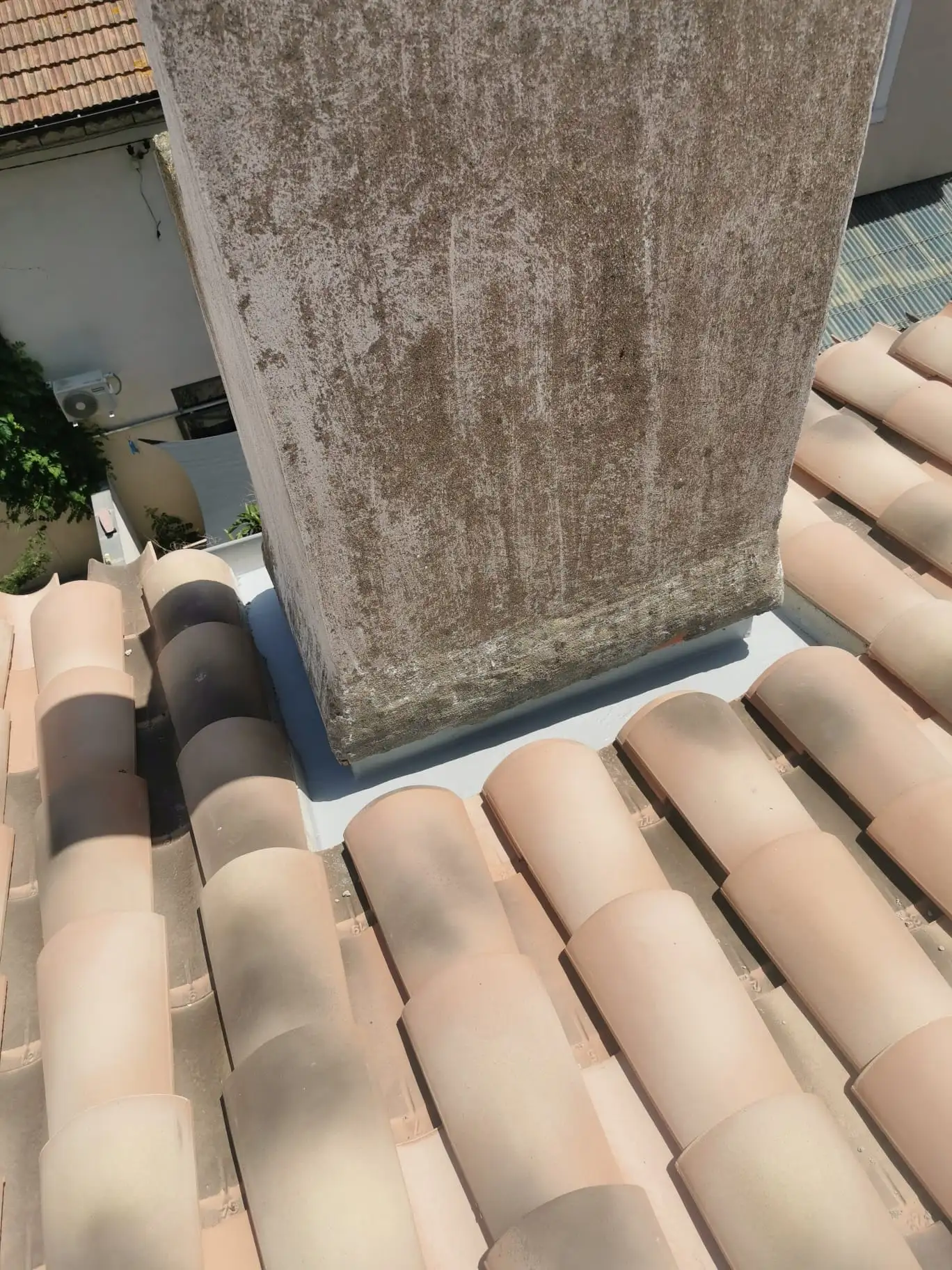
Zinc work — “zinguerie” — covers everything that carries water once it has left the tiles: gutters, box gutters and downpipes, but also the metalwork of the roof itself, valleys, verge trims and flashings. It is as much the roofer’s trade as the tiling, and it is the part you notice least while it is working.
It is also the only part of a roof you can judge from your own garden. A downpipe that overflows, a green streak on the render, damp at the foot of a wall: the diagnosis is already made by the time you call. What is left to decide is how it gets put right.
Assessing the roof
What tired rainwater goods are telling you
All of these can be seen from the ground. None of them needs anyone to go up to be confirmed — which makes this service unlike the others.
-
It overflows in every storm
Either it is blocked, or its fall is too shallow, or its section can no longer take what the slope sends it. All three are fixable, but not in the same way.
-
The wall is staining under the gutter
A green or black streak down the render means repeated overflow at the back: water is passing between the gutter and the fascia instead of running into it.
-
Damp at the foot of the wall
A downpipe discharging straight against the base of the façade, with no shoe and nothing to take it away, saturates the same patch of ground every time it rains. The consequences show up inside, often years later.
-
The joints are weeping
Zinc is soldered; a failed solder drips continuously, including in dry weather after rain. On PVC it is the seals that age.
-
The gutter has come away in places
Loose brackets cost the run its fall: water stands in the dips, silt settles, and the load in a freeze becomes considerable.
-
A box gutter overflowing inwards
The most treacherous case, because nothing shows outside. A saturated box gutter backs up under the tiles at the foot of the covering and attacks the fascia and the ends of the boarding directly.
Saturated rainwater goods cause damage that is taken for a roof leak almost every time. See leak detection
How it goes
Hanging a gutter, setting by setting
Nothing spectacular, and that is the point: it is all decided in adjustments of a few millimetres that nobody will ever see.
-
Taking the old one off, and checking the fascia
With the old gutter down, you can finally see what was holding it. A fascia board that is waterlogged or gone soft will hold no bracket: it is dealt with first, never afterwards.
-
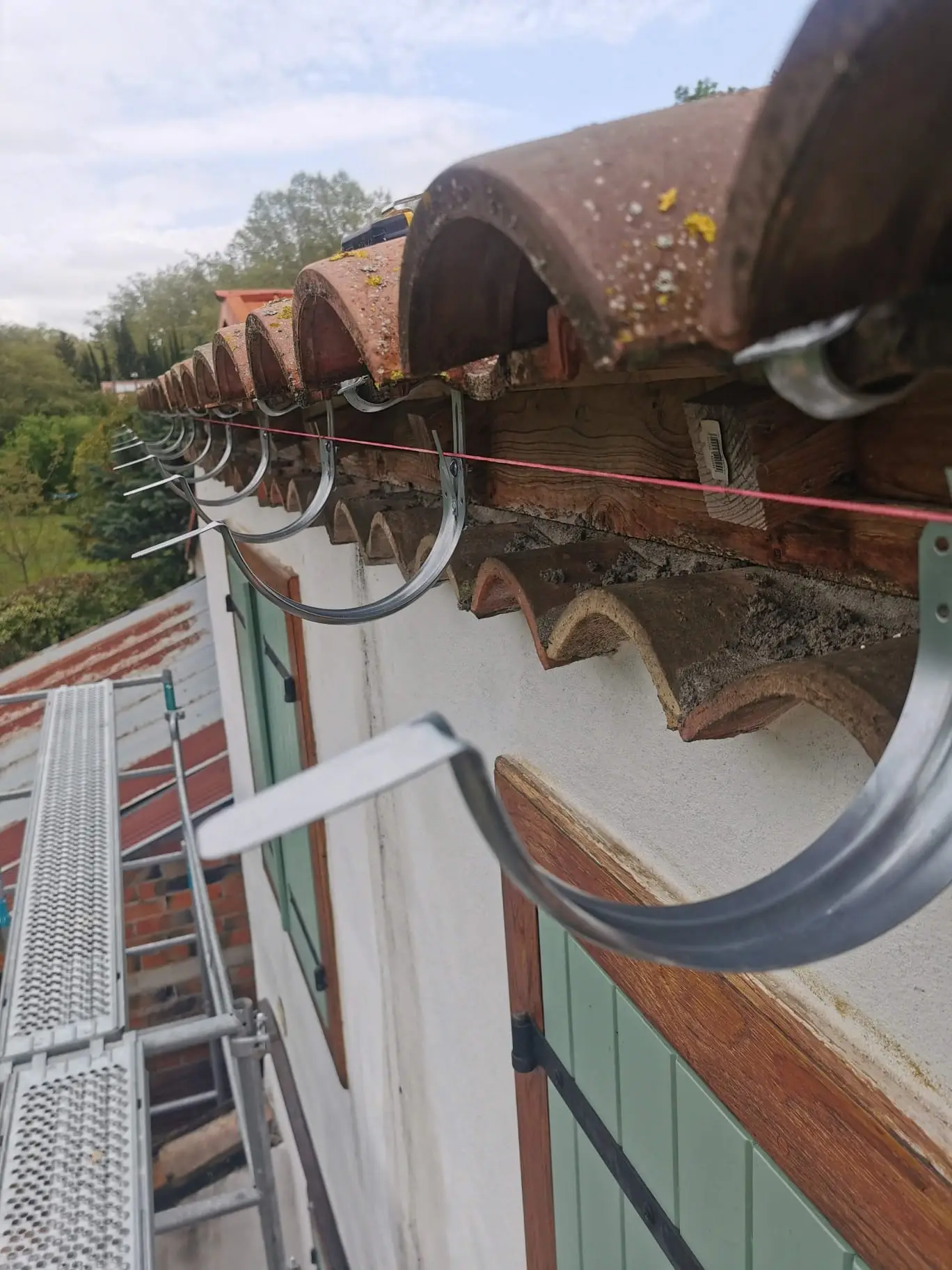
The string line, and the fall
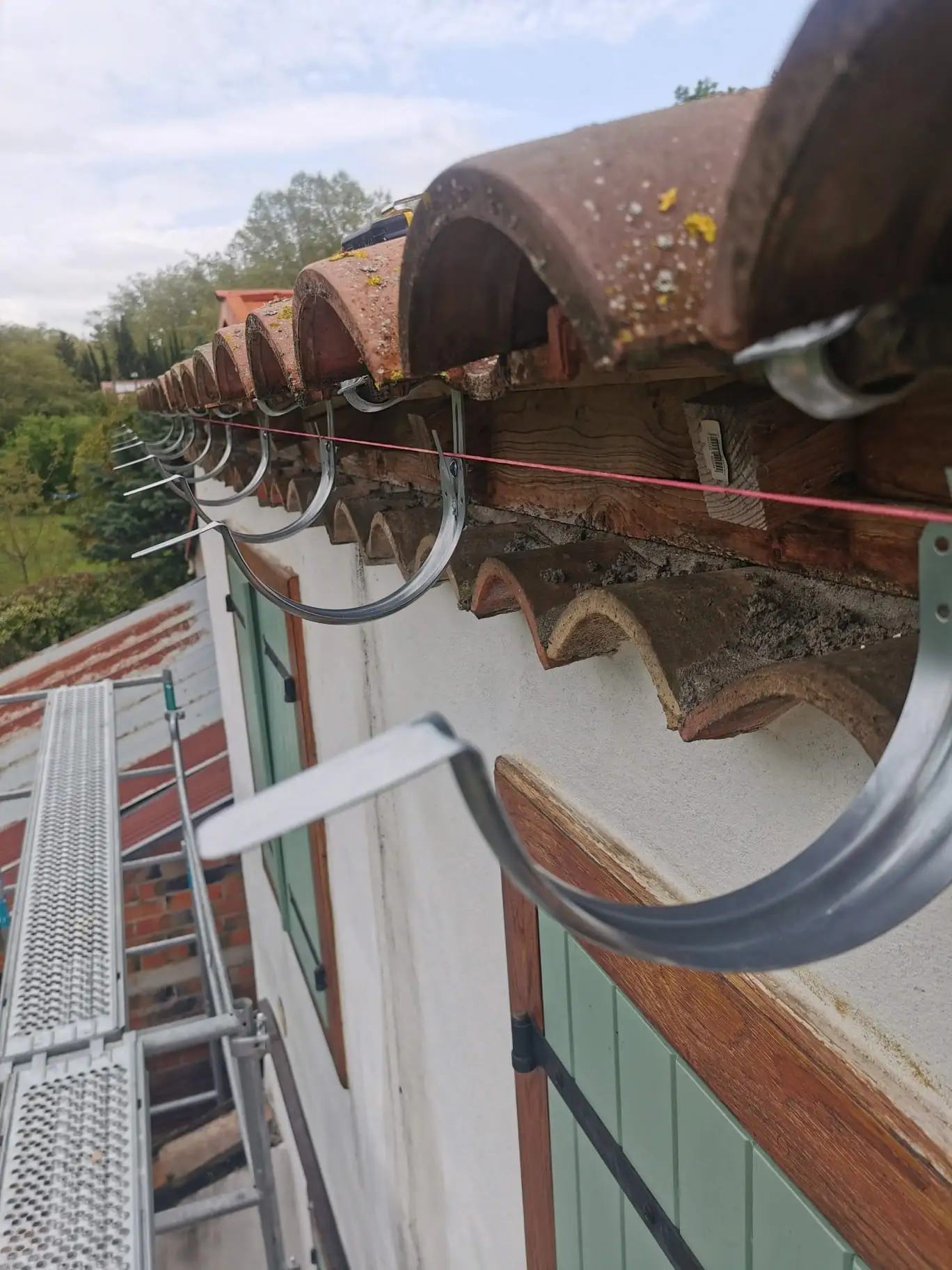
This is the setting that decides everything. A line is pulled taut from one end of the eaves to the other, and the fall is set against it — a few millimetres per metre, towards the outlet. Too little and water stands; too much and it runs fast enough to go over the front edge in heavy storms.
-
The brackets
They are aligned on the line and fixed at even centres. That spacing is what decides how the run holds up under the weight of water, snow and accumulated leaves.
-
Outlet, downpipe and discharge
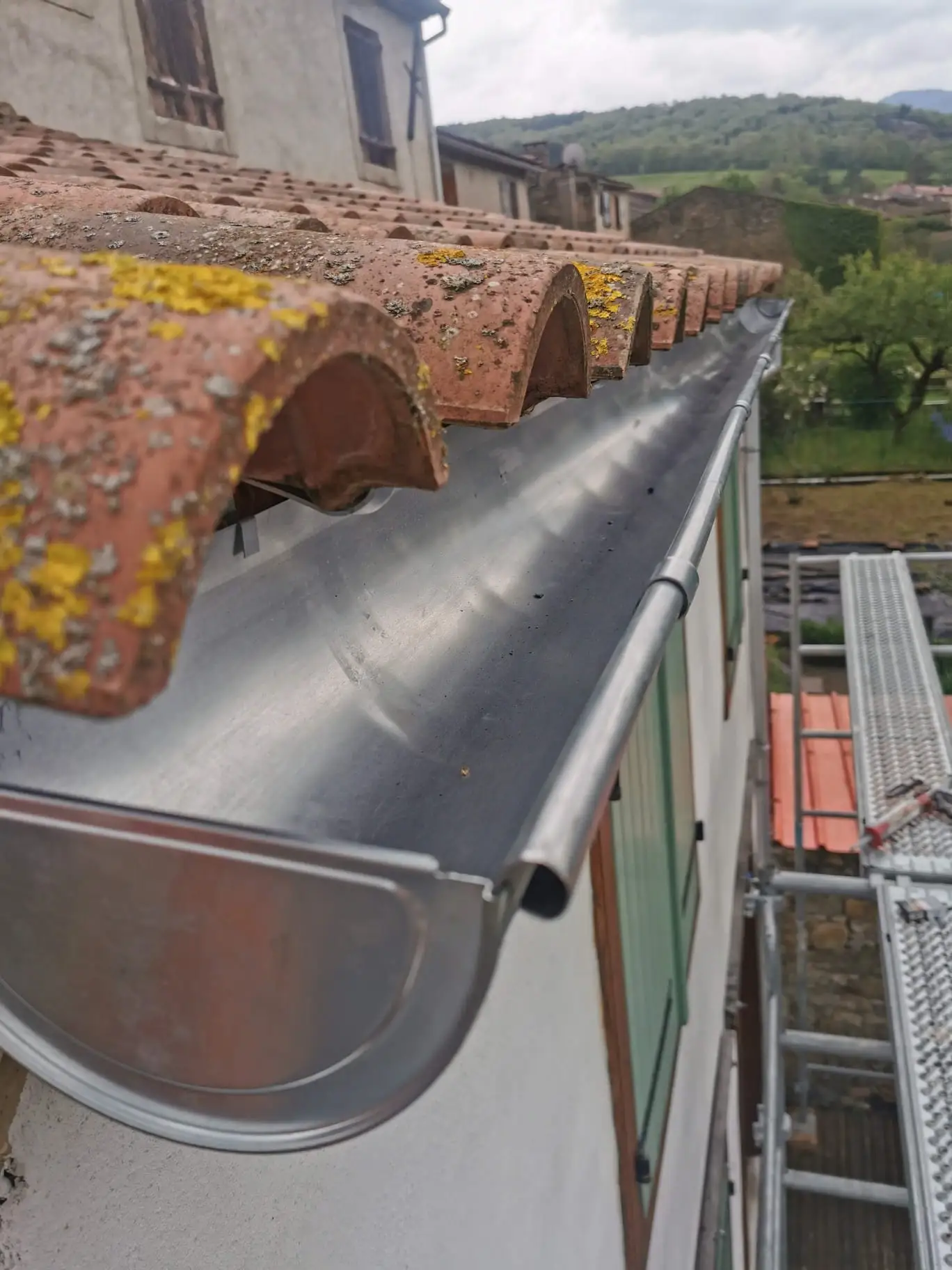
The outlet is cut at the low point, the downpipe run plumb down the façade, and the discharge taken away from the foot of the wall — a shoe, a gully or a connection, according to what the house allows.
-
Testing with water
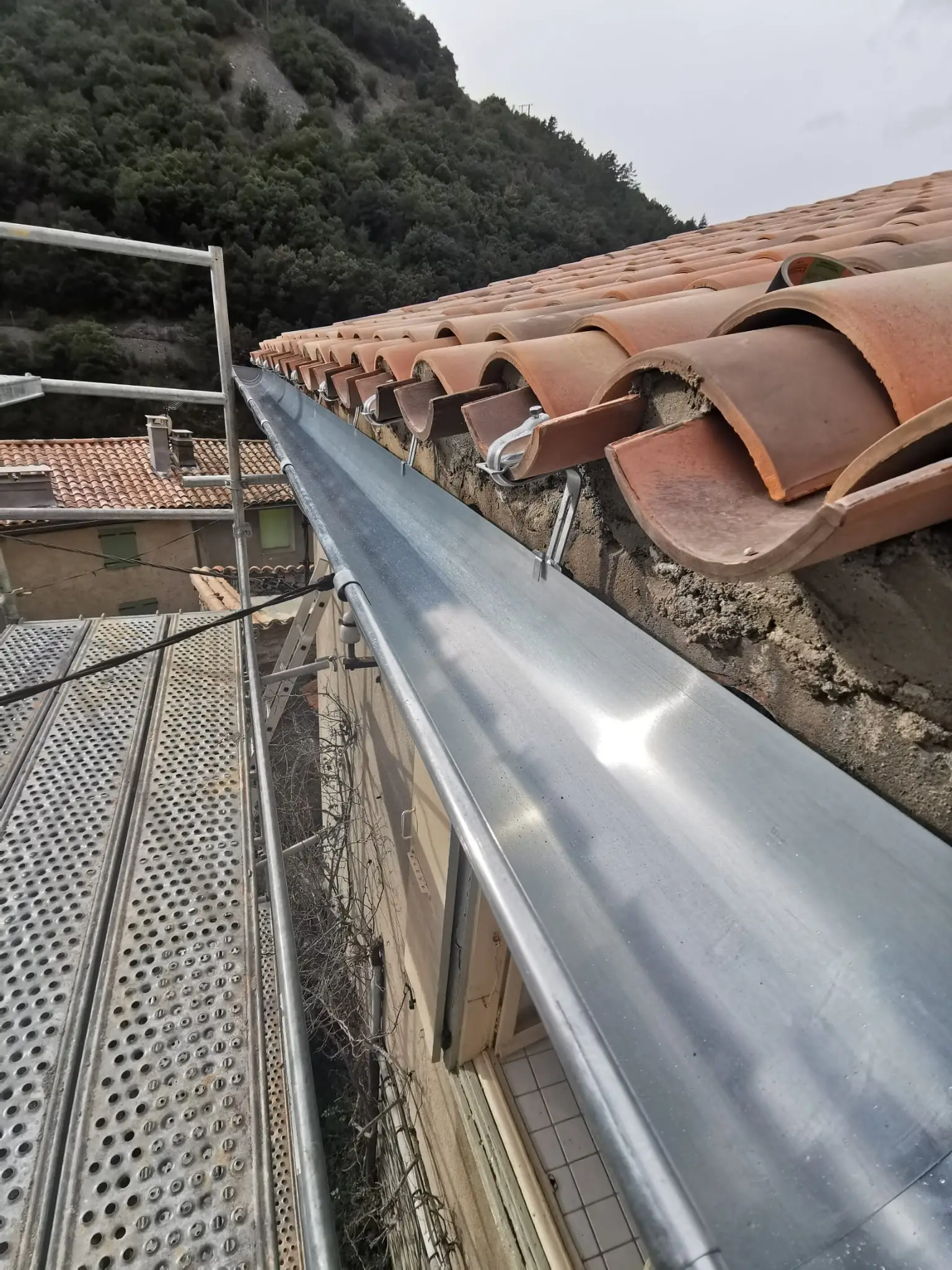
You put water down it. It is the only check worth anything: it reveals the low points the eye cannot see and the joints that weep, before the first downpour finds them for you.
Zinc or PVC
What actually separates them
Both hold water. The difference lies elsewhere: in how long they last, in how the work ages, and in what the house deserves. On a stone village house, white PVC guttering shows — that is a legitimate choice, but it should be made knowingly.
Zinc is joined by soldering: a continuous run, with no seal that can harden and split. It weathers to a matt grey and disappears against an old façade. It takes a particular skill, and that skill is exactly what the word “zinguerie” names.
PVC is push-fit, costs less to install, and copes poorly with wide temperature swings: it moves, and its joints are the first thing to fail. On an outbuilding, or anywhere appearance is not the point, it does the job perfectly well.
- Zinc is soldered: the run is continuous, with no seal to age.
- PVC expands and contracts; its joints work with every change of season.
- Against an old façade, weathered zinc goes unnoticed — white PVC does not.
- A single section can be replaced without redoing the whole run, in either material.
What people assume about a gutter
- What people assume If it overflows, it is blocked.
- What actually happens Not always. It may simply be undersized for the roof area it collects, or have lost its fall because a bracket gave way. Three different causes, three different repairs.
- What people assume Zinc lasts forever.
- What actually happens The metal does, for a very long time. What fails first is the brackets and the joints: a corroded bracket lets the gutter sag, water sits, and the low point eventually perforates.
What a storm teaches you
- Where it overflows Watch during the storm, not after. Overflow in the middle means a lost fall; at the ends, a saturated downpipe.
- Marks on the wall A vertical run below the gutter says exactly where it overflows, even months later.
- The sound of the downpipe An irregular gurgle points to a partly blocked pipe, usually at a bend.
- Plants in the gutter Grass growing means accumulated soil — so water that has been sitting there for a long time.
What gets checked on a rainwater system
- We measure the area collected Then compare it with the downpipe section. It is a calculation, not an impression, and it is rarely redone after an extension.
- We check the fall with a level End to end. A flat gutter holds water, and held water is heavy — that is what pulls the brackets out.
- We test the brackets One by one, by hand. A corroded bracket can be felt before it can be seen, and it makes the whole line sag.
- We check the drip edge What forces water to fall INTO the gutter rather than creep back under the tile. Without it, the rafter feet take water permanently.
- We follow the connection to the ground A downpipe discharging against a wall or into a blocked gully simply moves the problem lower down.
On site
From strip-out to discharge
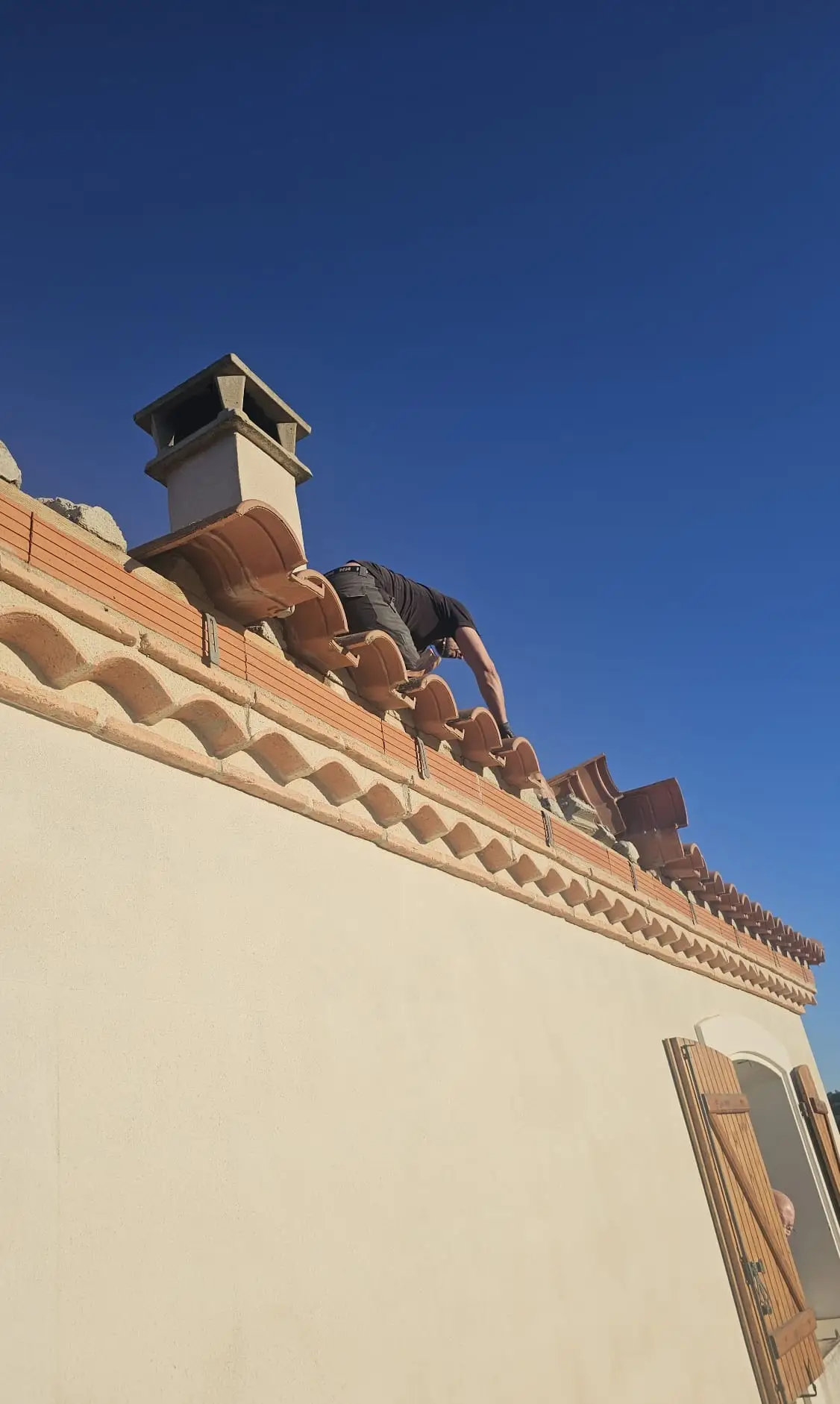
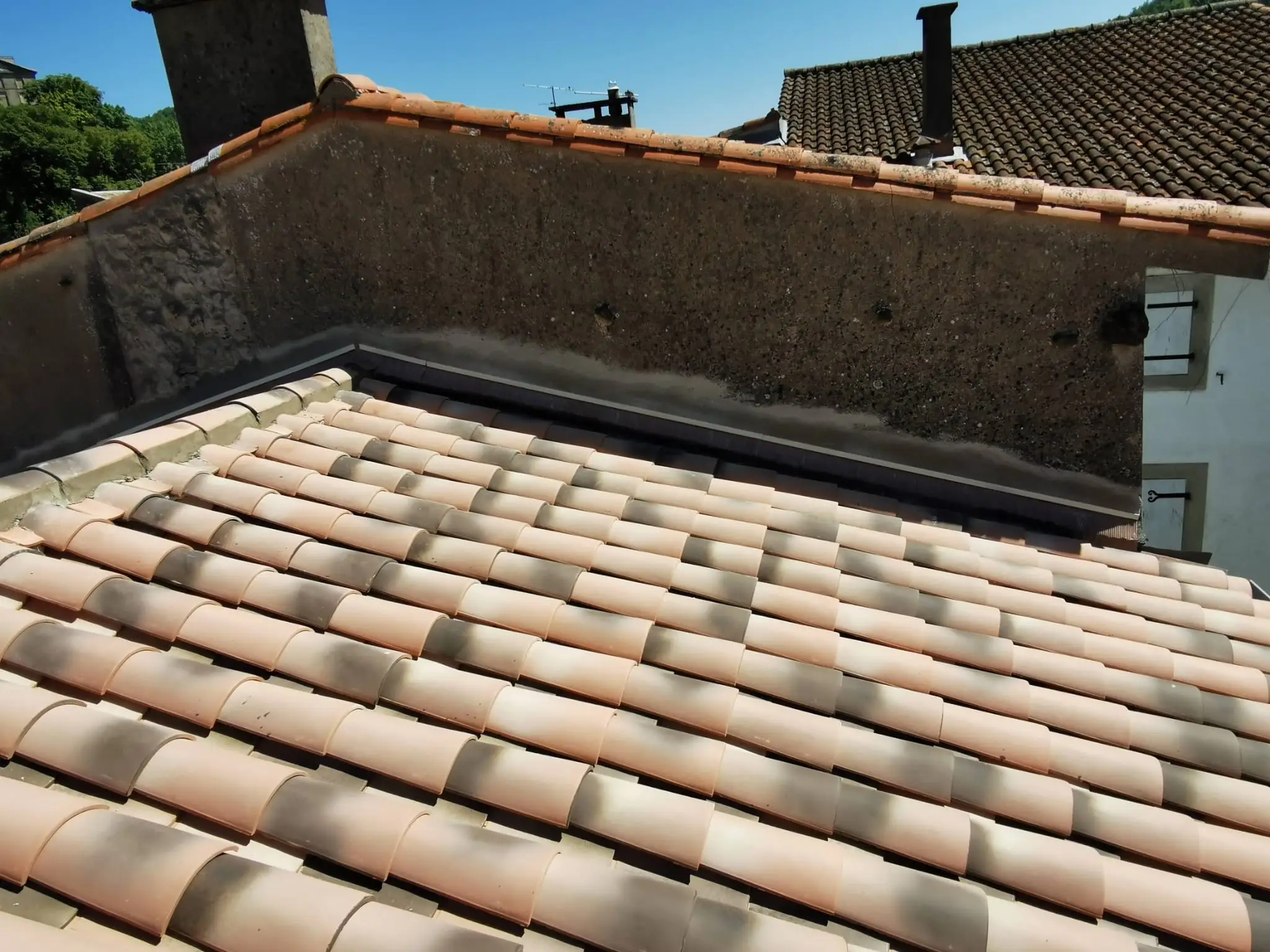
These three photographs document the same service at three different moments. All MBS Roofing Work South France sites.
What gets settled at the same time
- Roof renovation and re-roofing The scaffold is up and the eaves are within reach — the moment to replace tired guttering rather than come back to it in two years.
- Ridges, verges, closures and chimney flashing Flashings, verge trims and abutments against masonry are the same trade as the gutter: roof zinc work.
- Roof cleaning and moss removal A box gutter blocks from above. Cleaning the covering and clearing the outlets are two halves of the same maintenance.
Where we work
Zinc work is done from the eaves: a short job, often without a full scaffold. Our four areas cover the Haute-Vallée de l’Aude, the Minervois and the Alaric, the Corbières, and the Montagne Noire and Cabardès.
Minervois & Alaric Haute-Vallée de l’Aude Corbières Montagne Noire & Cabardès
Common questions
Zinc or PVC?
On an old stone or lime-rendered house, zinc weathers and disappears where white PVC stays visible. Technically, zinc is soldered — the run is continuous, with no seal to age — while PVC is push-fit and moves with temperature. PVC remains a reasonable choice on an outbuilding, or where the budget decides.
What fall should a gutter have?
A few millimetres per metre towards the outlet, set to a string line from one end to the other. It is very little, and it decides everything: too shallow and water stands and silts up; too steep and it picks up enough speed to overshoot the front edge in a heavy storm.
How often should gutters be cleared?
Entirely according to what falls into them. Under a plane tree or a pine, one autumn is enough to fill a gutter; in open ground the rhythm is far slower. The useful marker is not the calendar — it is the first overflow.
Can just one section be replaced?
Yes, in either material. On zinc the new piece is soldered to what is there. The one thing to watch is matching the section and profile: a gutter of a different size changes how the whole run behaves.
What is the difference between a gutter and a “chéneau”?
A gutter hangs at the edge of the roof on brackets. A “chéneau” — a box gutter — is built into the structure, set behind a wall, a cornice or a parapet. It is far more discreet, and far more treacherous when it overflows: it backs up inwards, under the tiles, instead of spilling down the front of the house.
Guttering to put right?
Describe what you can see from the ground: where it overflows, how long it has been doing it, and whether the wall is marked. That is usually enough to place the problem.