
The guide
Understand your roof before you call
Four pages to identify what you can see, read a quote, know what will happen on your roof, and recognise the moment to deal with it.
An owner calling a roofer is almost always at a disadvantage: they do not know the vocabulary, they do not know how long the house will stand open, and they usually discover the problem the day the ceiling stains.
These four pages sell nothing. They set down what a craftsman explains on site anyway — but beforehand, and in writing, so the conversation can start in the right place.
They share one thing, and it is what makes them useful: every one of them starts from something you can SEE. A stain on a ceiling, an unfamiliar word on a quote, a season coming, a job about to start — never from a service to be sold. That is the opposite order to a company website, and it is the order in which questions actually arise.
None of them claims to replace a visit. A roof is judged by lifting tiles, and two very different causes often produce the same ceiling stain. What these pages give you is the vocabulary, the order of operations and the right things to look at — enough to know what is being proposed to you, and why.
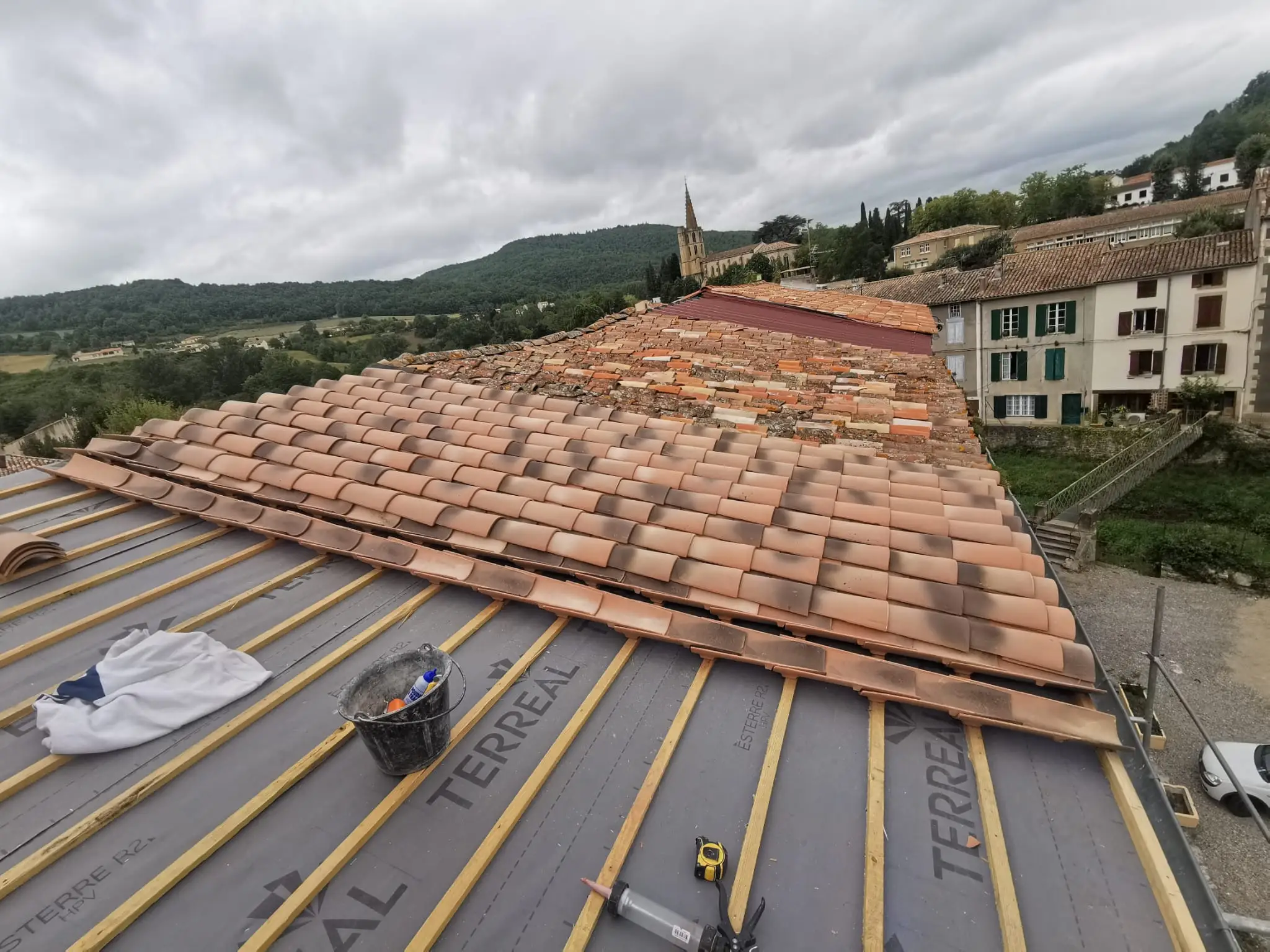
-
What is happening to your roof?
Two questions — what you can see, then a refinement — and the page tells you what it probably is, what you can check yourself, and which service it points to.
What is inside A stain on the ceiling Broken or fallen tiles A green roof, moss Water overflowing down the wall -
The roofing glossary
The 34 words that keep coming back on a roofer’s quote, each explained and drawn in its place. Six workshop plates, one for each part of a roof.
What is inside What carries the load What covers The bottom of the slope The top The edges The awkward parts -
How a roof job runs
From the first call to the last tile. What happens at each stage, what you have to do, and the only three stages during which your house stands open.
What is inside The call The survey The quote Scheduling Setting up and 5 more stages -
The roof care calendar
A roof does not decay steadily: it decays in episodes, and those episodes have seasons. Tramontane, frost, moss, storms — and what to look at through the year.
What is inside December — February March — May June — August September — November
What people assume about a roofing quote
- What people assume The cheapest is the one proposing the least work.
- What actually happens Not necessarily: it is often the one that did not look at the deck. Two quotes are only comparable if they separate what comes off, what goes back on and what is replaced — and if they state what happens should the deck prove damaged.
- What people assume Technical terms are there to impress.
- What actually happens They are there to be precise. “Re-battening” and “stripping the covering” describe two different jobs at very different cost. The problem is not that they exist — it is that nobody explains them.
- What people assume A guide on a tradesman’s site is filler for Google.
- What actually happens Often it is — and that is checkable in three clicks: if the pages say nothing you cannot find elsewhere, they exist for the search engine. These differ on one precise point: they explain the vocabulary of a quote, how a job actually runs, and the calendar of a Midi roof, with drawings made for the purpose.
- What people assume Better to just call — someone will explain.
- What actually happens Someone will, and that is the job. But a conversation in which you already know what a flashing, a valley or a gauge is does not take the same time and does not end in the same quote. You ask better questions, and you notice vague answers.
Which page to start with
- You can see something but do not know what The diagnosis. Two questions — what you see, then a refinement — and it tells you what it probably is.
- You have a quote in your hand The glossary. Thirty-four terms explained and drawn, in the order you meet them on a roof.
- You are hesitating about the work How a roof job runs. Above all it answers the real question: how long the house stands open.
- You have spotted something The calendar. It says what can wait, what cannot, and when nobody should be up there.
- You want to know who you are talking to The About page, at the foot of this panel, says what the firm displays and what it refuses to claim.
What this guide lets you do
- Read a line of a quote Every glossary term carries a drawing of the part in its real place in the structure. You can see what is being discussed.
- Ask the right questions Knowing that a flashing, a valley and a verge are three different things changes a conversation with a tradesman completely.
- Place work within the year A fault found in September gets dealt with; the same fault in December waits for March. The calendar says so season by season.
- Know what will happen at your house The ten stages of a job, in order, with what you have to do at each one.
- Start from a symptom, not a trade word A stain, a tile on the ground, a green slope: the diagnosis works back from what you see to the likely cause, and to the right page.
- Compare two quotes What a roofing quote must contain is set down in black and white at stage three of the job sequence.
- Recognise a vague quote A quote that writes “re-roofing” without separating stripping, relaying and replacement cannot be compared with any other. The guide says what it must contain.
- Know what cannot be priced The state of the deck under the tiles is only knowable once they are off. An honest quote says so; a quote that stays silent is preparing a surprise.
A question these pages do not answer?
Ask it. An owner who understands what is being proposed makes better decisions — and that stays true even when they choose someone else.