
Service 02
Roof repairs and tile replacement
A cracked tile, three tiles moved by a gale: the fault is visible, it is contained, and it is dealt with as such. The only real question is how far it goes.
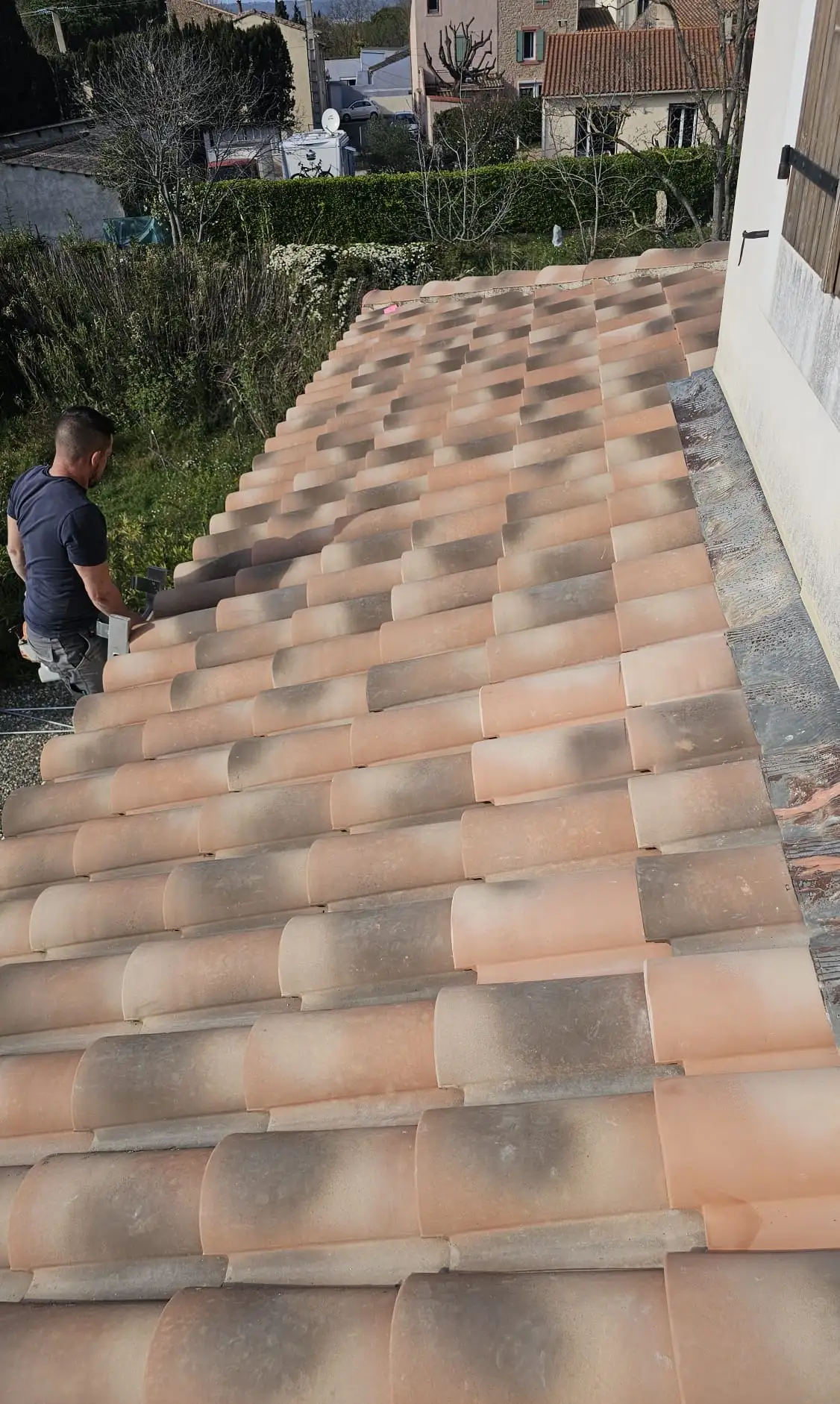
A roof repair is no more improvised than a re-roof, but it has nothing in common with one. There is nothing to trace: you can see what is wrong from the ground, or from a neighbour’s window. What has to be established is how far the problem actually extends — because a slipped tile almost never travels alone.
On the old canal-tiled roofs of the Minervois and the upper Aude valley, a contained repair raises a second question that catches most owners out: what do you replace it with? A brand-new tile set among tiles that have weathered for fifty years is visible from the street.
Assessing the roof
What a contained repair covers
These faults are dealt with where they are, without touching the rest of the slope. It is by far the commonest case, and by far the cheapest.
-
Tiles taken off by the wind
The Cers rarely leaves just one tile on the ground. It shifts one, then uses the gap to lift others. The repair is as much about checking the whole course around it as about putting tiles back.
-
A cracked tile spotted from the ground
A branch, an aerial, someone walking on the roof: the tile splits and nothing else moves. The simplest case there is — provided you can find one that matches.
-
Tiles that have slipped
On a roof laid dry, a cover tile can slide a few centimetres. It no longer laps the tile beneath, and water goes straight onto the deck — without a single tile being broken.
-
Moss that has lifted a course
Moss gets into the lap, swells with every downpour and eventually forces the tiles apart. The fault can be put right, but it will come back if the cause is not dealt with too.
-
A loose ridge end or verge tile
The edges are always the first to move. A ridge end that has come off leaves a direct opening into the covering, and it does not close itself.
-
A few frost-damaged tiles in a sound slope
A tile that is flaking and sounds hollow has had its life, but as long as it stays isolated, targeted replacement is more than enough.
If the same spot fails after every repair, or if water appears with no visible way in, it is no longer a repair job. See leak detection
Matching the tiles
Finding a tile that matches — not a tile that is new
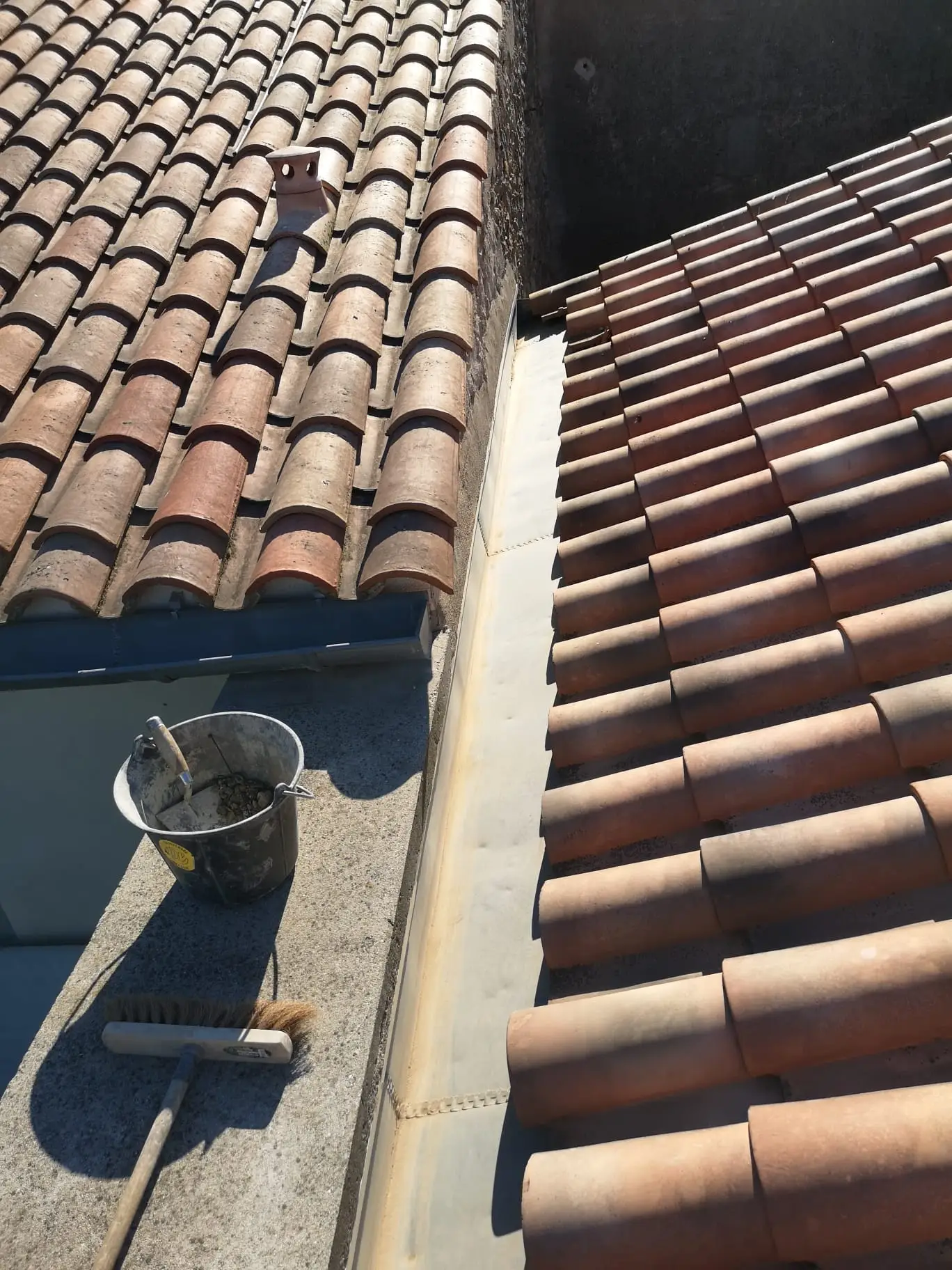
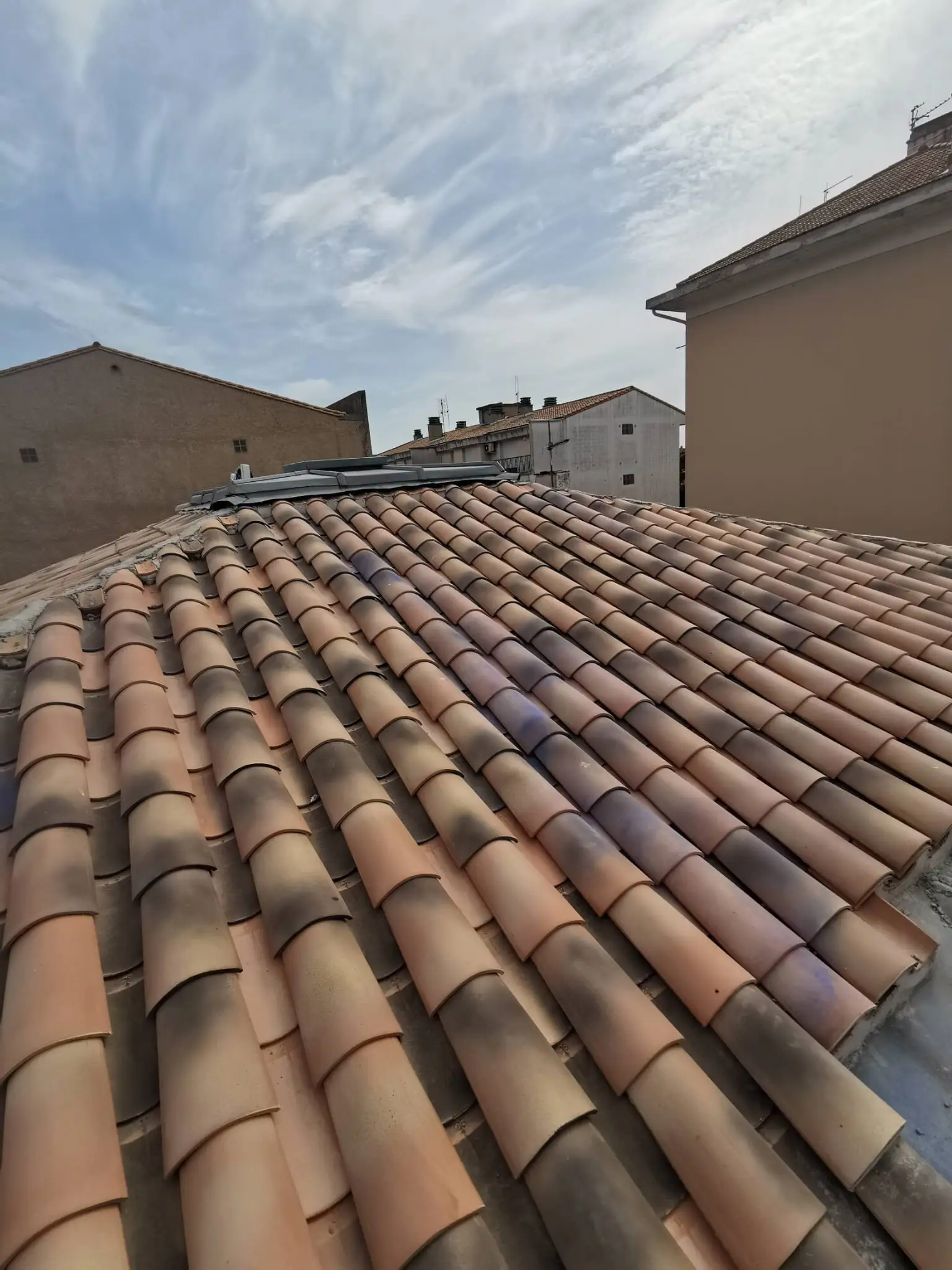
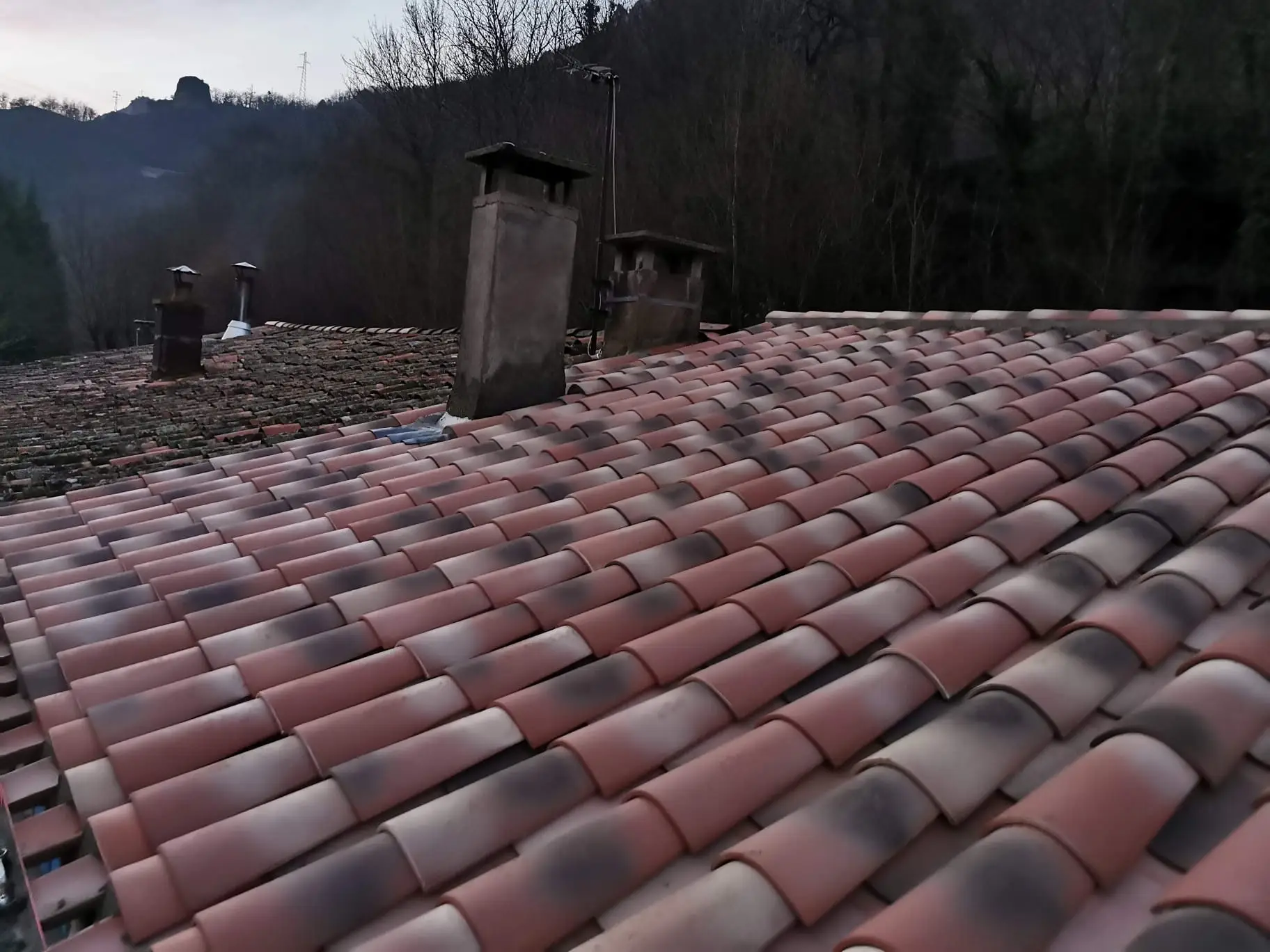
This is the real subject of any repair on an old property here, and the one nobody warns you about. A canal tile weathers for decades: it greys, it takes on yellow lichen, it colours according to which way it faces. A tile straight from the factory — same model, same shade — has none of that. Set on its own in the middle of a slope, it is visible from the road.
There are three ways out, and which one applies depends on the roof. The neatest is to move tiles around: sound old tiles are lifted from somewhere nobody looks — a rear slope, a low run behind a wall — and used where the roof is seen, with the new ones going where they will never be noticed.
It is also why sound tiles taken off during a re-roof never go in the skip. This is exactly what they are for.
- Move the old tiles to where the roof is seen, and put the new ones out of sight.
- Look for reclaimed tiles of the same size and curve — the curve matters as much as the colour.
- Failing that, choose a mixed-tone new tile and accept that weathering takes years.
The limit
When a repair stops being worth it
A contained repair deals with a fault, not with a cause. While the covering around it is sound, that is exactly the right thing to do. The arithmetic changes once repairs start stacking up: three call-outs in two winters overtakes what putting that section right would have cost.
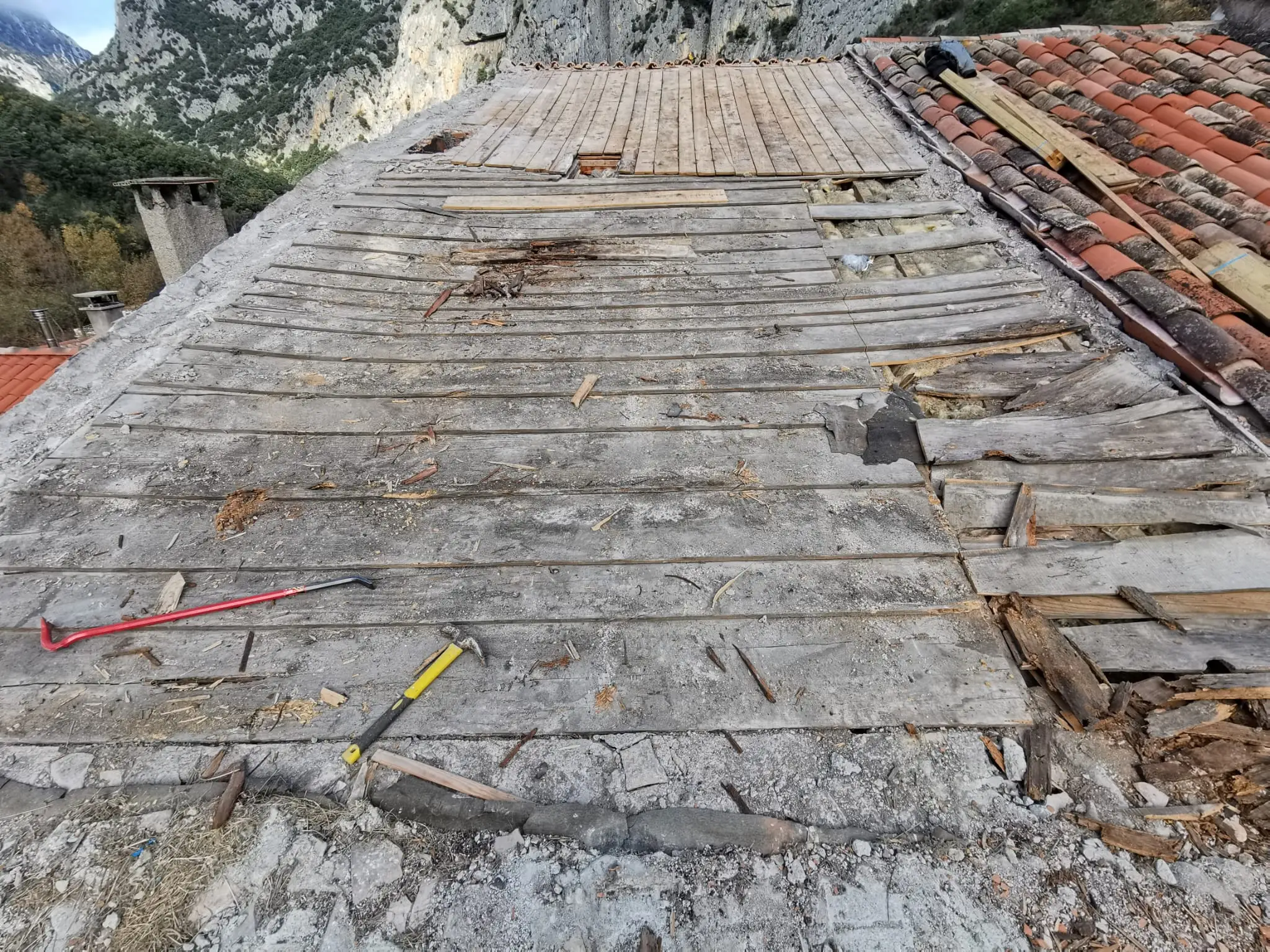
The second signal cannot be seen from the ground: the state of the deck. If the boarding has moved under the tiles, the courses will come out of line again however well the repair is done. That is what gets looked at from up there, and it is what tips the decision one way or the other.
What people assume about a repair
- What people assume A repair always shows.
- What actually happens Not if the tiles are matched. Work done with reclaimed canal tiles, sorted to approach the colour already there, becomes invisible from the street within a season. It is new tiles laid on their own that can be spotted from a hundred metres.
- What people assume Might as well wait and do the lot.
- What actually happens That is the most expensive calculation available. An infiltration lasting two winters turns a repair into a partial re-roof: timber is not repaired, it is replaced.
What calls for a spot repair
- One or two broken tiles, visible from the ground Usually after a blow. They are replaced, and above all we look for whatever gave the wind its grip.
- A tile that has slipped It stays put and goes unnoticed. Yet it is what lets water in at every driving rain.
- A loose verge course The mortar crumbles, the course moves. Caught early it is half a day; left, it is a whole slope.
- A fresh, isolated ceiling stain One point, not three. That means an awkward detail, so localised work.
How a repair is handled
- We look for the cause, not the symptom A broken tile is rarely the problem: what allowed wind or water to move it is what counts.
- We open up around it A few tiles either side, to see the state of the deck under the affected area before closing up.
- We match the tiles Sorting through reclaimed stock to approach the colour in place. That is what makes a repair invisible.
- We check the course above Faults spread up the slope: the course above has often moved too, without showing.
- We photograph what was found You will not go up to look. What you cannot see, we show you.
On site
Repairs, before and after
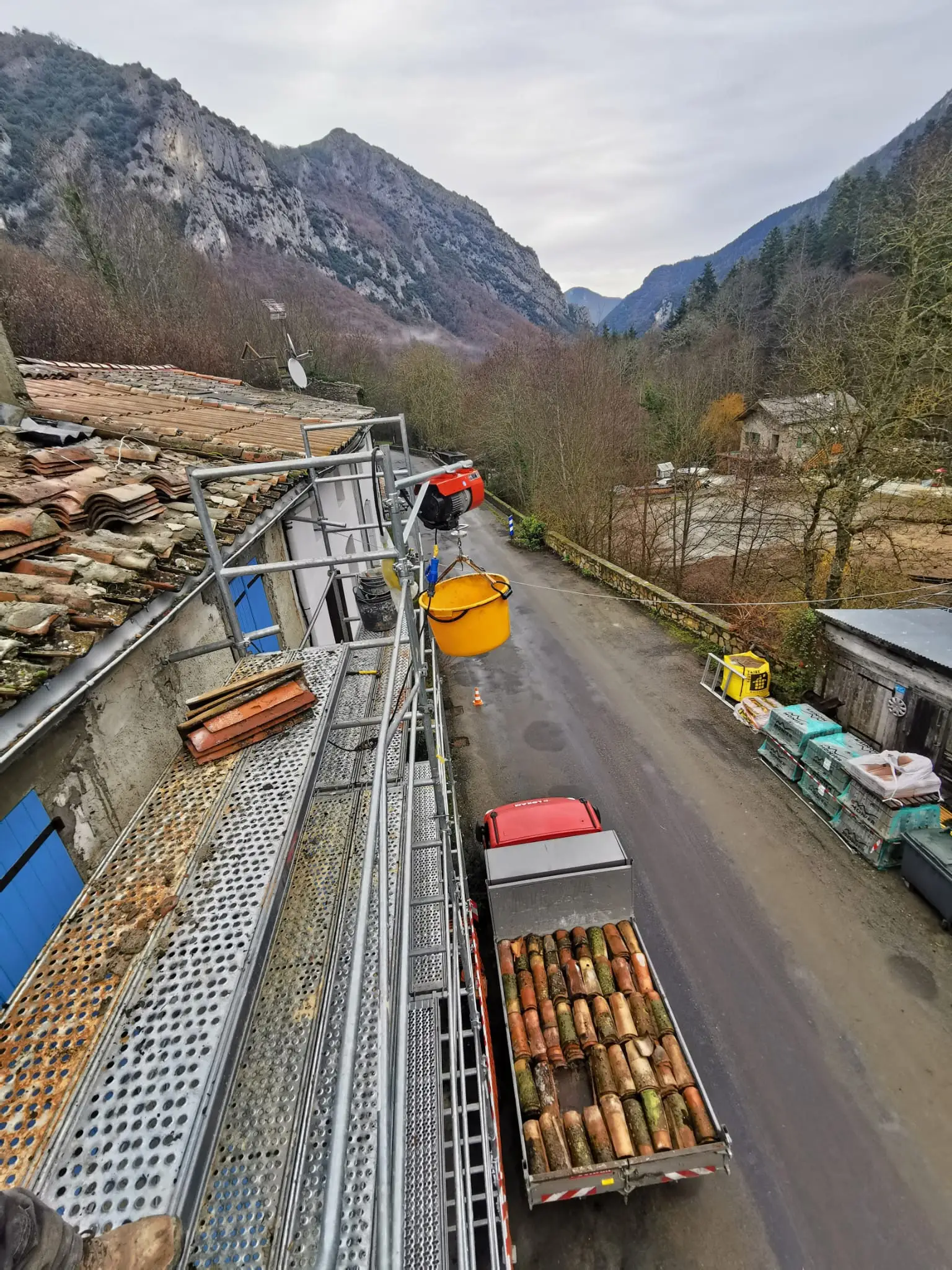
All MBS Roofing Work South France sites. No stock photography anywhere on this site, and nothing staged.
The neighbouring services
- Roof leaks and urgent repairs When water is getting in and you cannot see where, it is not a repair job — it is a search. Different work entirely.
- Roof cleaning and moss removal Moss is behind a good share of slipped tiles. Dealing with it is how you avoid the next repair.
- Roof renovation and re-roofing Once the deck has moved, or repairs keep coming, re-laying that section becomes the sensible sum again.
Where we work
A repair is a short job: it plans easily, and being nearby saves the waiting. Our four areas cover the Haute-Vallée de l’Aude, the Minervois and the Alaric, the Corbières, and the Montagne Noire and Cabardès.
Minervois & Alaric Haute-Vallée de l’Aude Corbières Montagne Noire & Cabardès
Common questions
Can a roof be repaired without redoing all of it?
Yes, and that is the usual case. A tiled roof is repaired course by course, tile by tile, without touching the rest of the slope. Re-roofing only becomes the answer if the deck has moved, or if the same faults return after every repair.
Can you still get old tiles?
Yes, but matching is not only about colour: size and curve matter just as much, and they vary between makers. Where reclaimed tiles are not available, the neatest answer is to move tiles around — old ones to where the roof is seen, new ones where nobody will look.
One cracked tile — is that really worth a visit?
A cracked tile lets water onto the deck every time it rains, and on an older roof with no underlay there is nothing underneath to stop it. The cost of dealing with it bears no relation to the cost of a deck that has to be rebuilt two years later.
The wind has moved some tiles — should I wait for better weather?
You have to wait until the roof can be walked safely; a wet or windy covering is not walkable. But do not wait beyond that: a displaced tile gives the next gale exactly the purchase it is looking for.
How do I know whether the fault is isolated?
By going up. From the ground you can see what is broken; you cannot see tiles that have slipped two centimetres, the state of the deck, or what is happening under the lap. That is precisely what separates a real quotation from an estimate made through binoculars.
Tell us what you can see
How many tiles, whereabouts on the roof, and since when. A photograph taken from the ground is very often enough to start the conversation.