Skip to content
Roofing Minervois & Haute Vallée de l'Aude

Service 05

Ridges, verges, closures and chimney flashing

A tiled roof almost never leaks in the middle of a slope. It fails where the covering stops: at the top, along the edges, and wherever something passes through it.

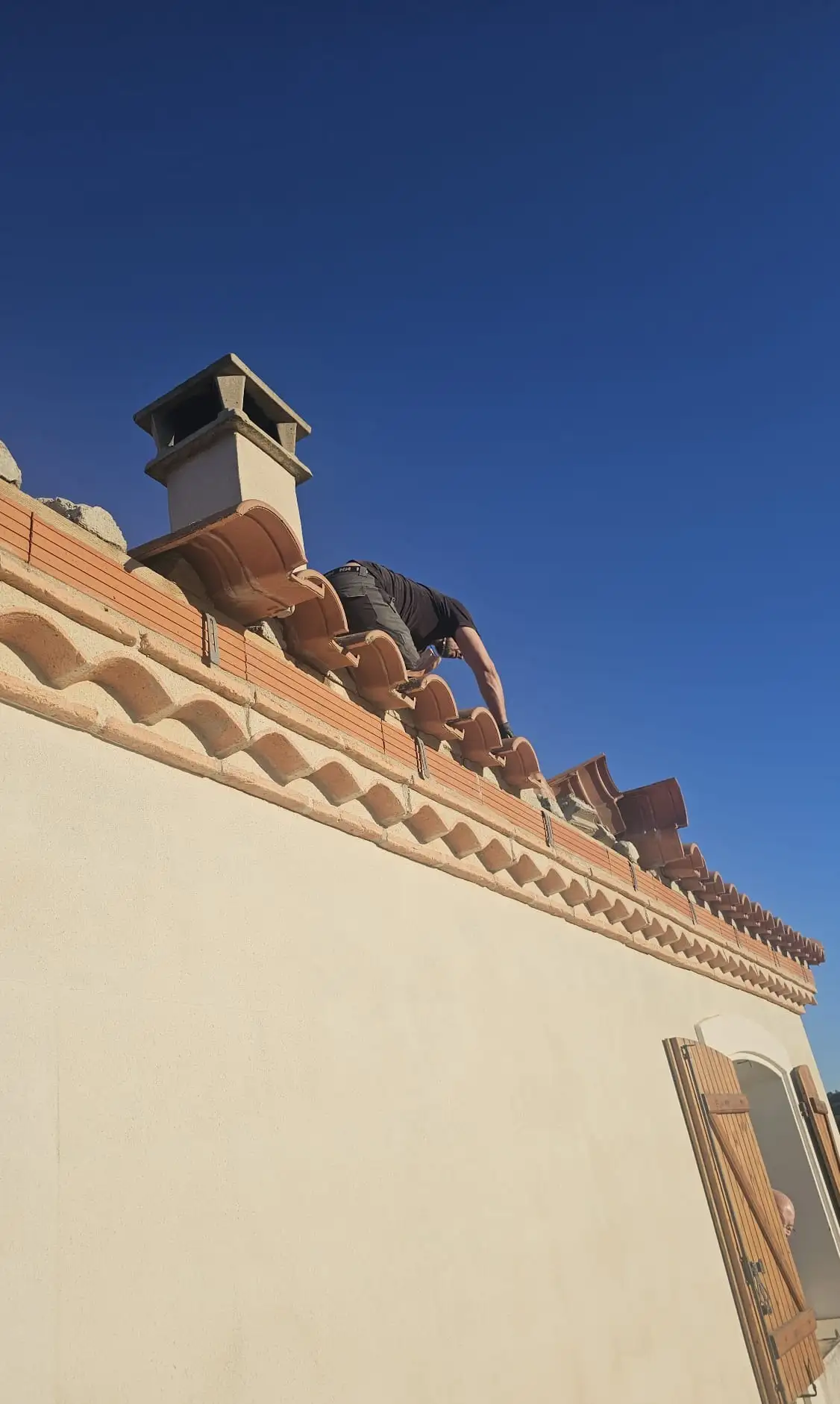
Seen from below against a deep blue sky, the roofer sets the verge tiles along the top course, beside a capped chimney stack

In the middle of a slope, tiles do exactly one thing: they lap each other. As long as that lap is respected, water runs off and nothing happens. The trouble starts where the lapping stops — at the ridge, where two slopes meet; at the verges, where the covering ends over thin air; at the flashings, where it runs up against masonry that does not move the way it does.

In French these are called the “points singuliers”, and they account for most of what goes wrong on a tiled roof. They are also the only parts that can be rebuilt without stripping the covering — which is what makes looking after them worthwhile, and neglecting them expensive.

The critical details

The three details that hold a roof together

Each has its own job, its own way of failing, and its own French name. Recognising them is most of what it takes to read a French quotation.

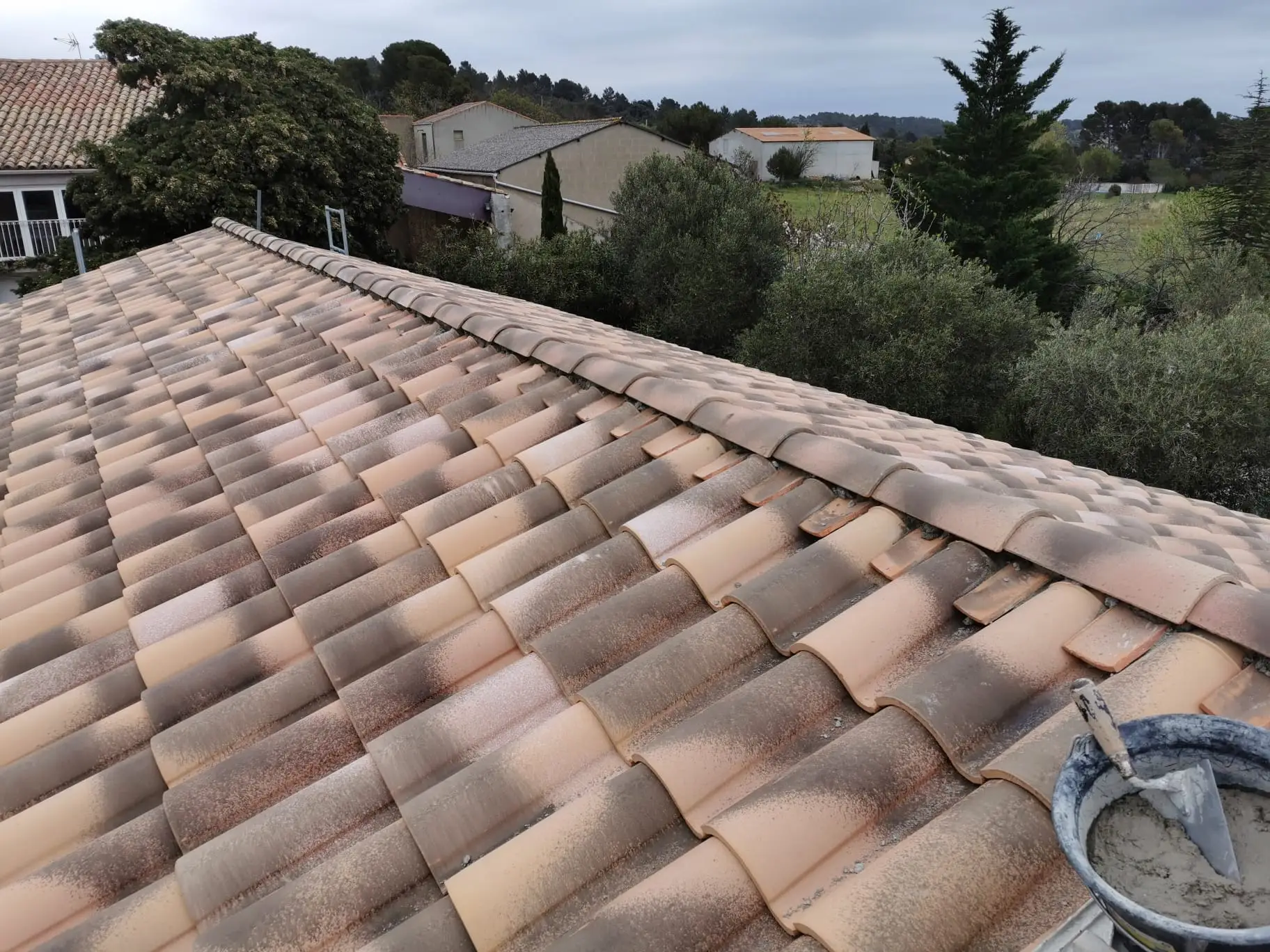
A mortar-bedded ridge being laid on a new roof in mixed-tone tiles, with a bucket of mortar and a trowel set down at the edge of the slope

The ridge — “le faîtage”

The line where two slopes meet, and the one place on a roof where water cannot simply run downhill: it has to be turned away. Ridge tiles — “faîtières” — lap the top course of each slope and close the covering off at the top.

The ridge has a second job that gets far less attention: it ventilates. A tiled roof breathes at the eaves and at the ridge. A ridge that is completely sealed traps moisture under the tiles, and it is the timber underneath that pays for it.

How it fails

The mortar bedding cracks as it expands and contracts, and the ridge tiles work loose one after another. Wind then gets under the ridge line and drives rain back up against the fall, exactly where there is no lap left to stop it.

  • faîtière — ridge tile
  • about de faîtage — ridge end
  • scellement — mortar bedding
  • ventilation
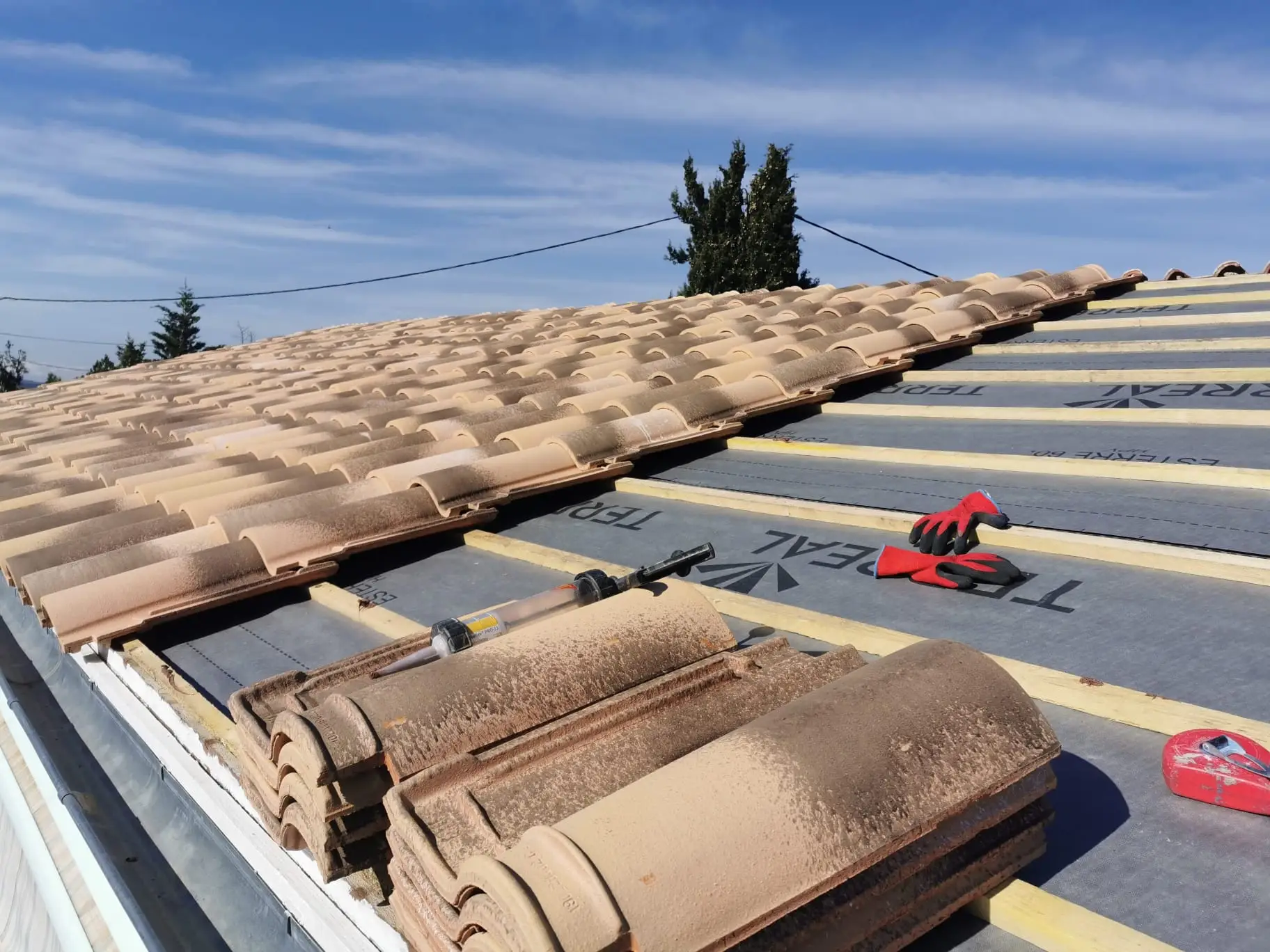
The verge and eaves of a roof in progress: new tiles laid to the left, fresh underlay and battens to the right, verge tiles and a mastic cartridge in the foreground

The verge — “la rive”

The verge is the side edge of the covering, the one that stops over a gable or a wall. It is finished either with verge tiles — tiles with a return that closes the edge — or bedded in mortar onto the masonry.

It is the roof’s leading edge. Under the Cers, the westerly that sweeps down the Aude valley and across the plain, the verge takes everything: the wind is looking for a way underneath, and for a course to lift.

How it fails

Verge mortar splits, one tile lifts, and the wind has its grip. Every episode widens the opening. A verge left open eventually disturbs courses well beyond the edge itself.

  • tuile de rive — verge tile
  • mortier de rive — verge mortar
  • planche de rive — fascia
  • pignon — gable
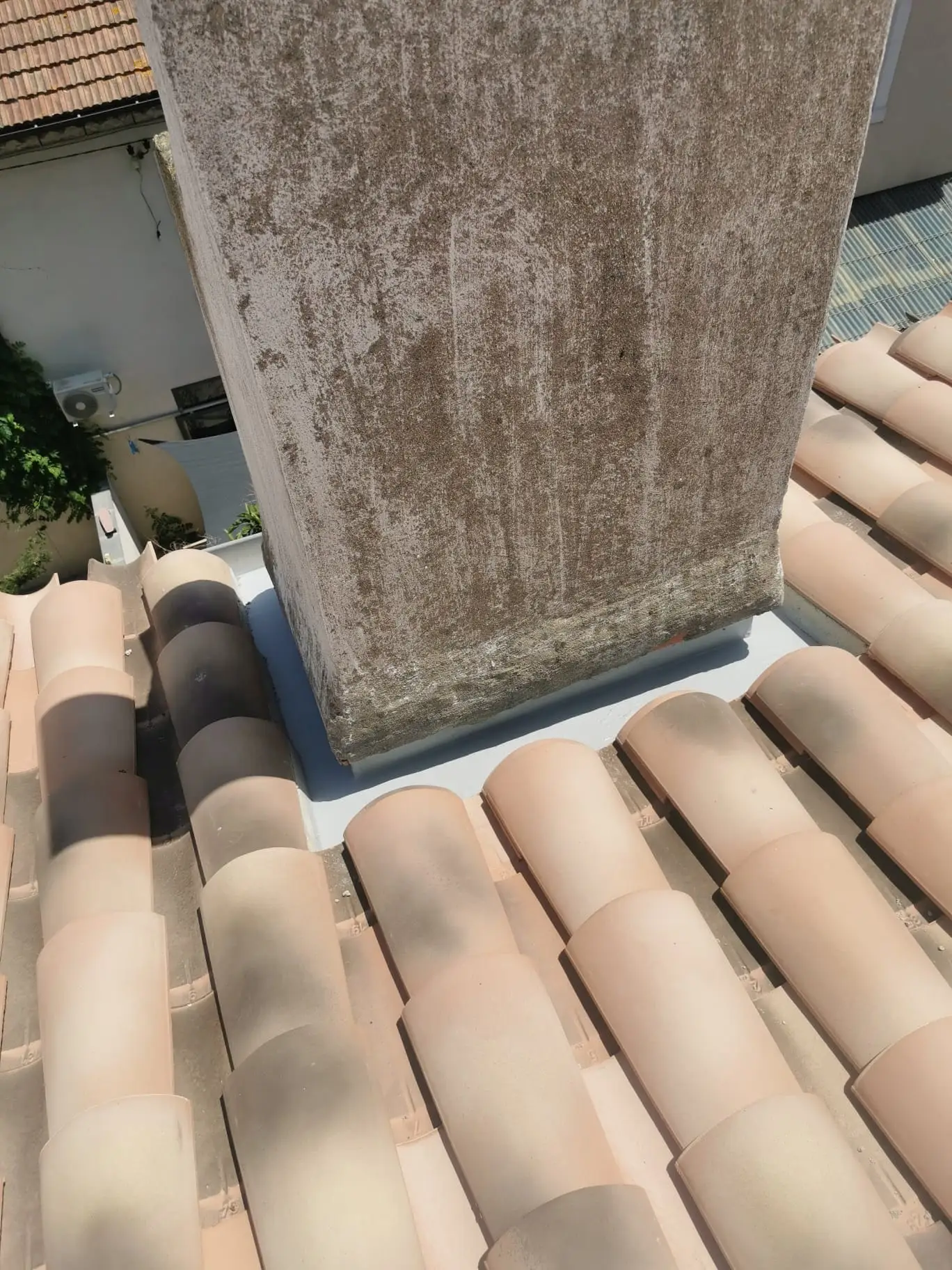
The base of a masonry chimney stack with new flashing running neatly around the whole perimeter where it meets the canal tiles

Flashing — “le solin”

A flashing is the join between the covering and masonry: a chimney stack, a party wall, a cross wall standing proud of the roof. It carries the weatherproofing across the point where two quite different structures meet.

It is the hardest-worked detail on the whole roof, for a simple mechanical reason: a chimney stack is founded on the ground, the roof structure moves with the seasons, and the two never move together. The join absorbs that difference permanently.

How it fails

A flashing formed in mortar alone always cracks in the end. Water then runs down the side of the stack, gets under the tiles and ends up in the roof space — very often without leaving anything visible from the ground.

  • solin — flashing
  • bande de solin — flashing strip
  • souche — stack
  • mitre — chimney pot

Two methods

Bedded ridge or dry ridge?

The question comes up on every ridge quotation, and both answers can be defended. Here is what actually separates them.

Bedded in mortar — “scellé” — Section through a ridge: mortar bedding on the left, ventilated dry-fix closure on the right.

Bedded in mortar — “scellé”

The ridge tiles are bedded in mortar onto the top course of each slope. This is the traditional method, and it is what the overwhelming majority of older roofs in this region have.

Ventilation

None at the ridge — it has to happen elsewhere, at the eaves or through vent tiles.

Wind resistance

Excellent while the mortar is sound. It is the mortar failing, not the wind, that opens the ridge line.

Maintenance

Mortar ages and cracks. On an older roof this is the detail to keep an eye on.

Appearance

The only finish that sits right on an old canal-tiled roof, and often the only one permitted in a protected area.

Dry-fixed on a ventilated closure — “à sec” — Section through a ridge: mortar bedding on the left, ventilated dry-fix closure on the right.

Dry-fixed on a ventilated closure — “à sec”

The ridge tiles are mechanically fixed to a batten, and a closure — a flexible, pleated, ventilated strip called a “closoir” — seals the joint between the ridge tiles and the covering. No mortar at all.

Ventilation

Provided by the closure itself: the air gap under the tiles discharges at the top.

Wind resistance

The fixing is mechanical and does not depend on mortar ageing.

Maintenance

Much lower. The closure is a consumable, but over a long life.

Appearance

The closure stays visible close up at the ridge ends. On a period property that is worth a conversation.

Section through a ridge: mortar bedding on the left, ventilated dry-fix closure on the right.

The choice cannot be made in the abstract. It depends on the state of the deck, on how the covering already ventilates, on how exposed the roof is, and very often on what the building itself requires. It is a matter of diagnosis, not preference.

Bedded ridge or dry ridge?

What people assume A dry ridge is weaker than a bedded one.
What actually happens It is mechanically fixed and demountable, which mortar is not. Above all it lets the air gap exhaust, which solid bedding prevents. On old fabric in a protected area, mortar is sometimes still required — that is a planning question, not a technical one.
What people assume A flashing is mortar against a wall.
What actually happens That is exactly what makes it leak. A flashing that lasts is chased into the masonry, with a cover flashing over its top. Without a chase, water always finds its way behind.

What can be checked from the street

  • The ridge line From a distance it should be dead straight. A step in it means dead bedding or a purlin that has moved.
  • The verge mortar If it is crumbling, it shows. It is the easiest fault to spot and the cheapest to put right early.
  • Chimney junctions A flashing patched with mastic stands out by its colour. It is nearly always the sign of an emergency repair.
  • Verge tiles standing proud An uneven course at the gable edge offers the wind exactly the grip it is looking for.

What is done at these points

  1. We sound the bedding by hand Mortar that rings hollow has let go, even if it looks intact. It is the simplest test, and nobody does it from the ground.
  2. We open a short length Old mortar crumbles from the inside: bedding is not judged on its surface.
  3. We check the flashing chase It either exists or it does not. In the second case the repair goes through the masonry, not just the metal.
  4. We check the high-level ventilation On a dry ridge the closure must be clear. Crushed or clogged, it kills the air outlet for the whole roof.
  5. We do the windward verges first West side first: that is where it starts, and where it costs.

On site

The details, finished

All MBS Roofing Work South France sites. These are the parts of a roof nobody ever looks at — and they decide everything else.

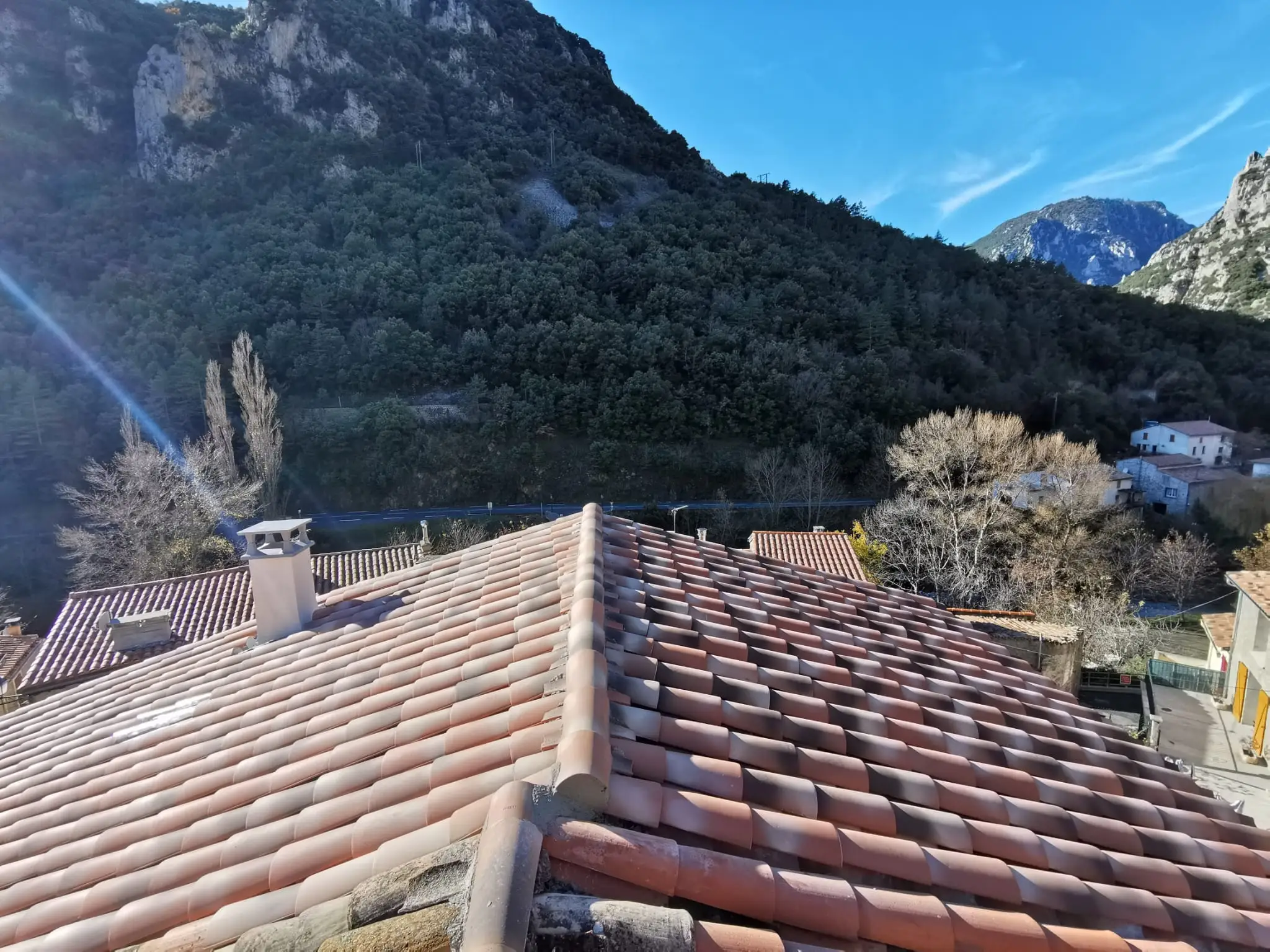
A new ridge seen along its length on a fully re-covered roof, with clear sky and limestone hills behind
A finished ridge line
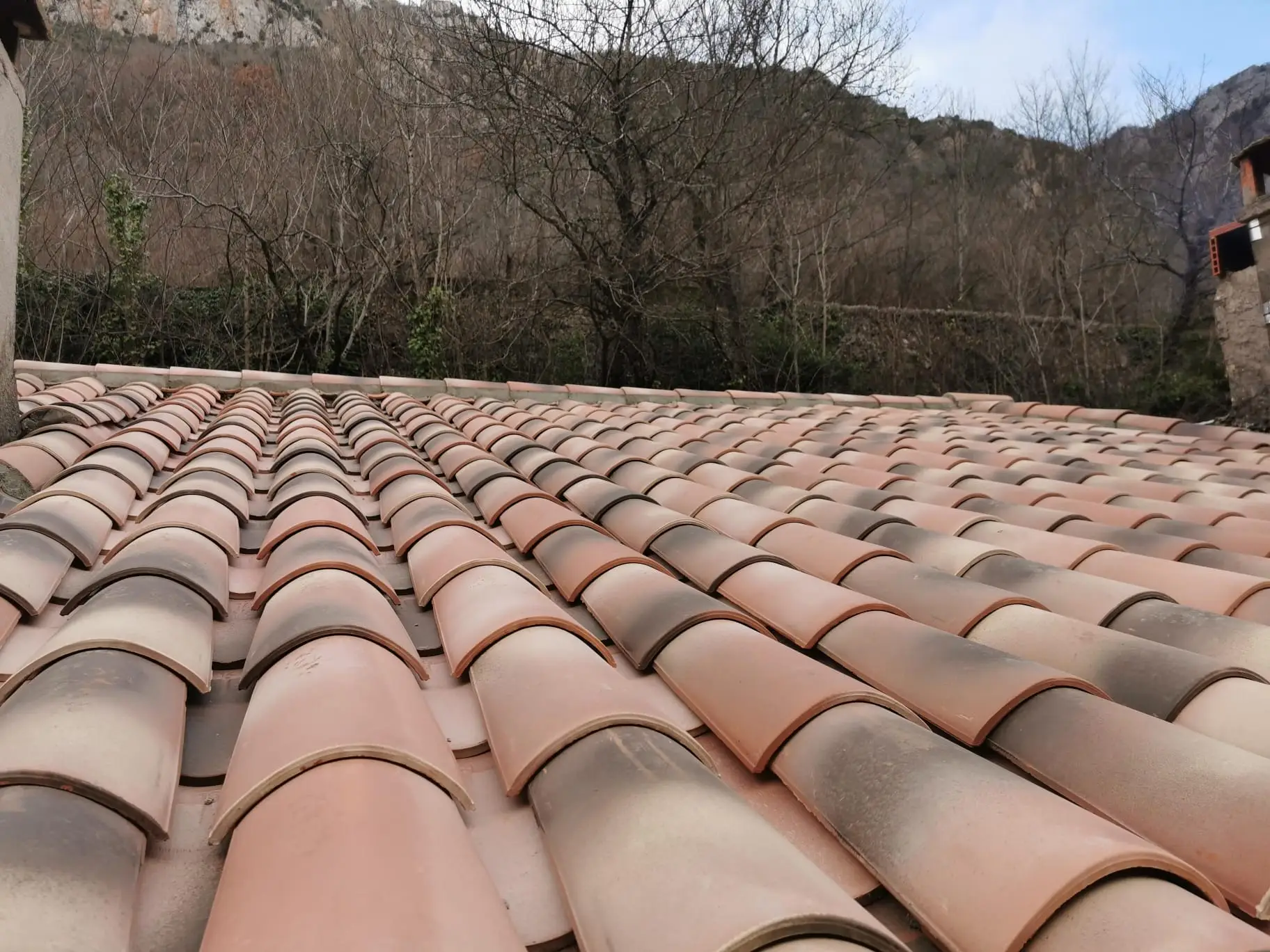
A renovated canal-tiled roof seen at a raking angle from the ridge, the courses converging towards a wooded slope and cliff face
A renewed slope, ridge to eaves
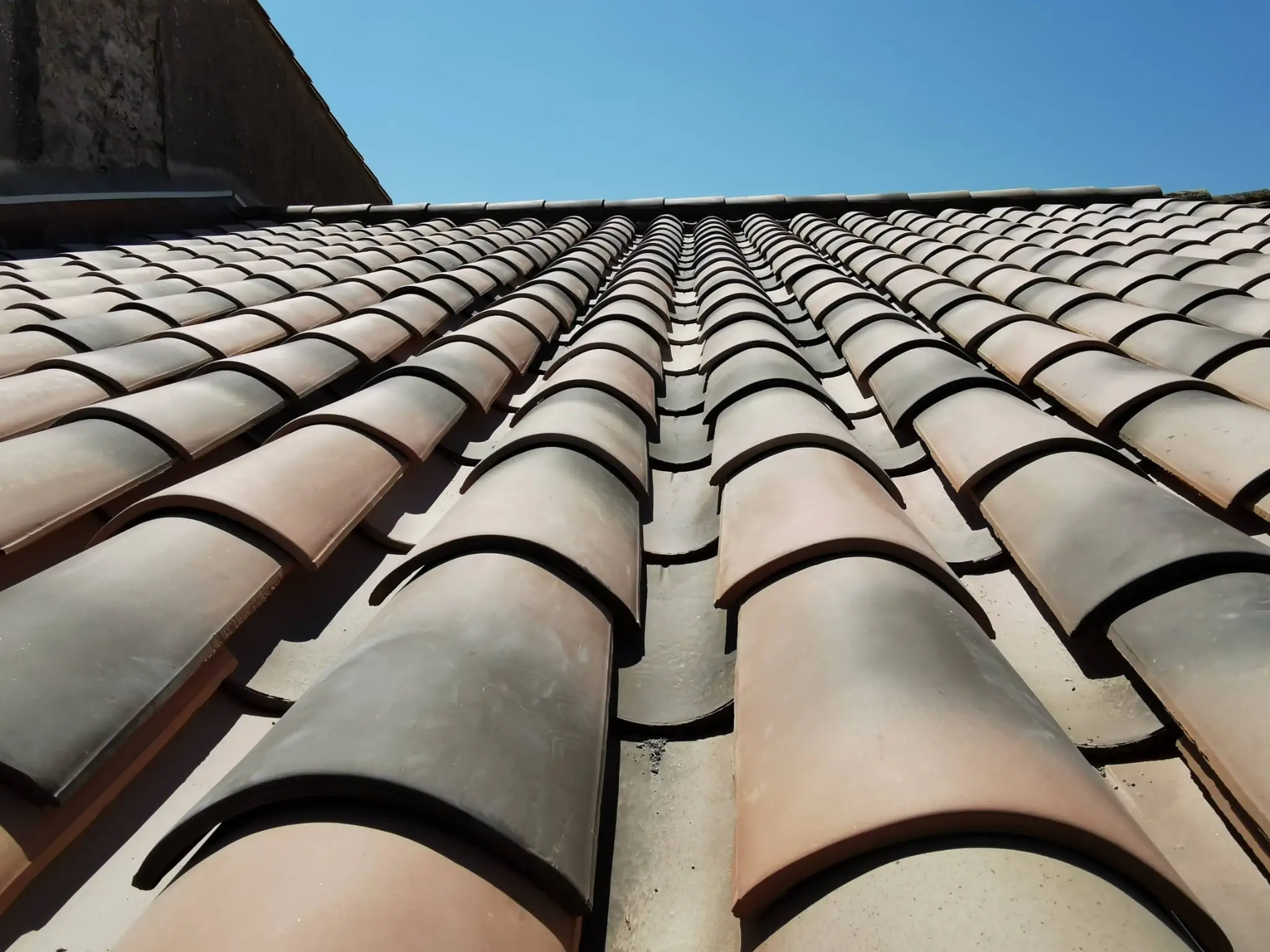
Looking up the line of the slope: rows of canal tiles running towards the ridge against a deep blue sky
Courses running up to the ridge

Common questions

Bedded or dry ridge — which should I go for?

It depends on the roof first. On an old canal-tiled covering, a bedded ridge is often the only finish that sits right with what is there, and sometimes the only one allowed in a protected area. A dry ridge brings ventilation at the top and removes the mortar maintenance, which is worth a lot on a new or newly re-laid roof. It is settled on the roof, not on paper.

What exactly is a “closoir”?

It is the piece that seals the joint between the ridge tiles and the top course, without mortar — a dry-fix ridge closure. A ventilated one is pleated and perforated: it keeps out water, birds and insects while letting the air that circulates under the tiles escape. It is what makes a dry ridge possible.

Why does flashing always fail eventually?

For a mechanical reason, not because of poor work. A chimney stack is founded on the ground; the roof structure moves with moisture and temperature. The two never move together, and the join absorbs that difference permanently. Flashing formed in mortar alone cracks in the end; flashing with a metal upstand takes that movement for far longer.

Does a roof really need ventilating?

Yes, and it is often the invisible half of the problem. A tiled roof ventilates at the eaves and at the ridge: air comes in low, leaves high, and carries away the moisture that gets under the tiles. A roof that is watertight but completely sealed rots its own deck from the inside, without ever showing a mark on a ceiling.

Can a ridge be rebuilt without touching the rest of the roof?

Yes — that is exactly the point of these details. They are rebuilt without stripping the covering. It needs safe access along the ridge line, the ridge tiles taken off, the bed cleaned out and the whole thing re-laid. The rest of the slope is not involved.

Can verges be done on their own?

Yes, in the same way: along the whole length, or just the failed section. It is a short job, and it is usually worth doing before winter — an open verge gets worse with every gale.

Got a ridge or flashing quotation to make sense of?

Tell us what you can see, or what you have been quoted. On these details the difference between two quotations often comes down to a single French word — and that word changes how long the work lasts.

Call Request a quote