
Area 02
Roofer in the Haute-Vallée de l’Aude
From Limoux up through the gorges towards Quillan, the valley gains height and loses mildness. Roofs here take more rain, more frost, and stand shoulder to shoulder.
The Haute-Vallée follows the Aude southwards, climbing steadily towards the Pyrenees. That gain in altitude changes everything: it rains more than on the plain, it freezes more often, and north-facing slopes never dry out completely.
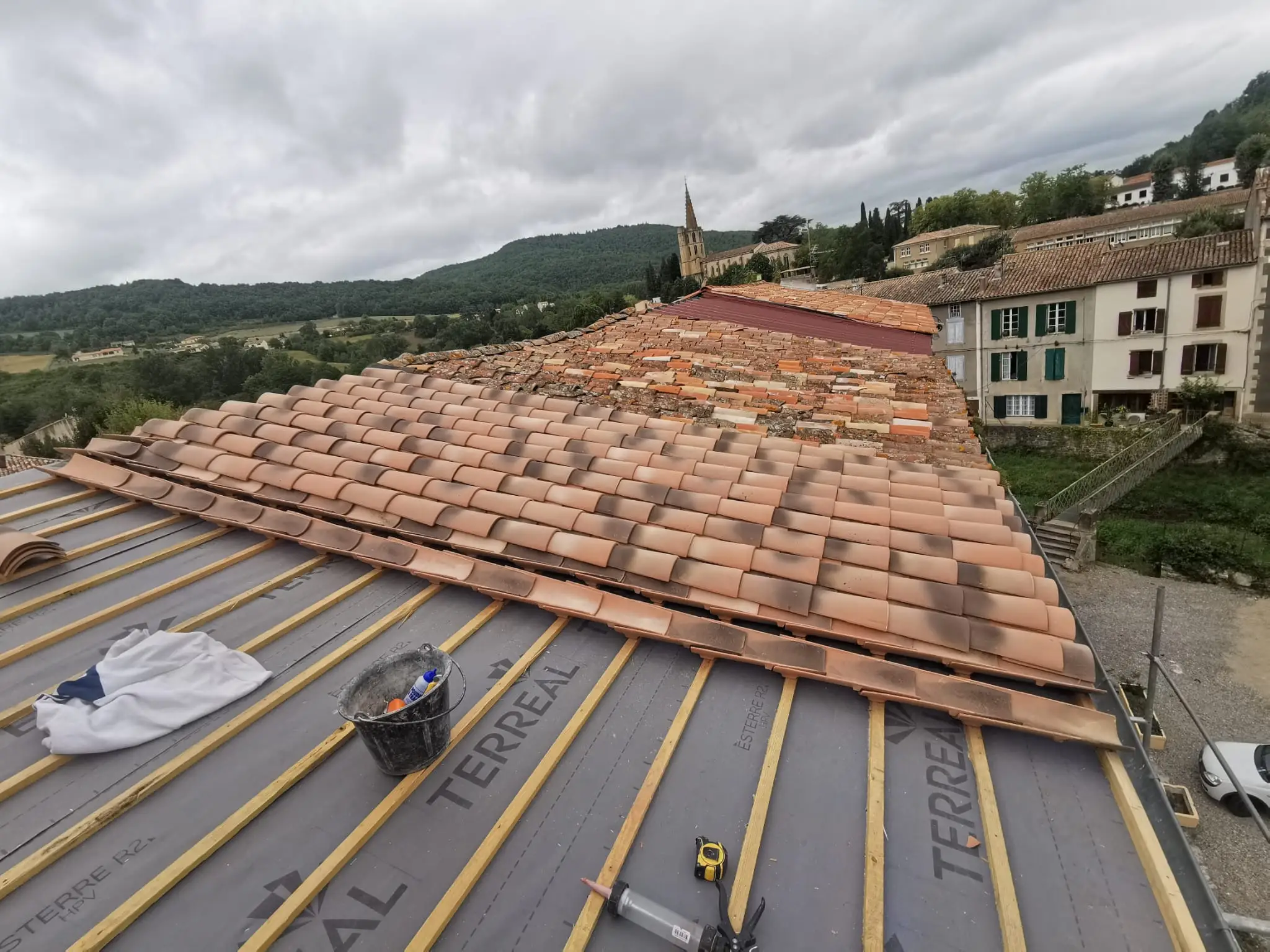
The buildings are those of dense stone villages: continuous party walls, narrow streets, roofs that touch and run into one another. Working on one is as much a question of access as of roofing.
The ground
What the valley does to roofs
Three characteristics of this landscape, and what each one does to a tiled covering.
-
More water, and more frost
Altitude brings higher rainfall than the plain and a greater number of freeze cycles. That is exactly what wears out a frost-susceptible tile: water held in its pores expands with every freeze, and the surface eventually delaminates.
-
North slopes that never dry
In a narrow valley, a north-facing slope sees very little direct sun in winter. Moss takes hold far faster than in open country, and it forces tiles apart well before it lets any water in.
-
Roofs that adjoin
In an old village centre a covering does not simply stop: it runs into the neighbour’s, against a wall standing proud or a shared stack. Those junctions are the hardest-worked details on the roof, and the hardest to reach.
What the valley suggests, and what it actually does
- What people assume A stone village house is solid — the roof will not move.
- What actually happens The masonry does not move; the roof on top of it does. Valley villages are built terraced, so there are wall abutments everywhere — and that is exactly where water gets in, never in the middle of a slope.
- What people assume Frost damages tiles.
- What actually happens Frost damages the WATER in tiles. A sound tile that sheds water comes through winter untouched. It is the already-cracked tile, or the already-porous mortar, that frost finishes off. The question is not the cold — it is what holds water.
- What people assume It can wait until spring.
- What actually happens That is the worst decision available in this valley. A fault found in October spends the winter getting worse under frost, and what was a tile in October will be a rafter by March.
The signs particular to the Haute Vallée
- North-facing slopes They dry slowly and hold moss. A dark green north slope means water held against the clay all through the bad season.
- Party-wall junctions In a tight village every house touches the next. Look at the junction from the street: the flashing should be clean, not patched with mastic.
- Delaminating tiles A tile splitting into flakes has taken water and then frost. It cannot be repaired, and it announces others.
- Downpipes, before November A downpipe blocked with leaves freezes first. It is the most worthwhile autumn check in the valley.
What we look at on arrival
- Cracked or delaminating tiles Before anything else. In this valley a hairline crack does not stay hairline: frost opens it further every winter.
- Party-wall junctions The villages are built tight. Every junction between two houses is a possible way in, and the hardest to see from the ground.
- The drainage, end to end Gutter, outlet, downpipe. Standing water that freezes distorts the ironwork and pulls the brackets out.
- North-facing slopes They do not dry all winter. That is where the covering ages fastest, and where we look first.
- The timber near the eaves From inside the loft. It is the first place permanent damp shows on the rafters.
Where it sits
The area, within the territory
The relative position of the four areas. The others are clickable — it is often the neighbouring one you were after.
Positions to scale · areas approximate · rings at 10, 20 and 30 km from Carcassonne.
- Minervois & Alaric The area MBS Roofing Work South France works from, running from the Aude plain to the lower slopes of the Alaric, and across into three villages in the Hérault.
- Haute-Vallée de l’Aude From Limoux up through the gorges towards Quillan — a valley of stone villages where roofs take a beating.
- Corbières Villages of real character with old roofs, where renovation has to respect what is already there.
- Montagne Noire & Cabardès Higher, wetter and more exposed — roofs age differently up here than they do down on the plain.
Villages and towns covered in this area
- Limoux
- Quillan
- Montréal
- Espéraza
- Couiza
- Pomas
- Pieusse
- Fanjeaux
- Belvèze-du-Razès
- Saint-Hilaire
- Cournanel
- Preixan
- Lauraguel
- Campagne-sur-Aude
- Cépie
- Val-du-Faby
- Magrie
- Montazels
- La Digne-d'Aval
- Rouffiac-d'Aude
- Puivert
- Axat
- Verzeille
- Malras
- Saint-Martin-de-Villereglan
- Alet-les-Bains
- Villesiscle
- Malviès
Show the other 89 villages in this areaCollapse the list
- Pauligne
- Villeneuve-lès-Montréal
- Alaigne
- Cambieure
- Villelongue-d'Aude
- Brugairolles
- Gaja-et-Villedieu
- Ginoles
- Lasserre-de-Prouille
- Antugnac
- La Digne-d'Amont
- Belvianes-et-Cavirac
- Roquetaillade-et-Conilhac
- La Force
- Nébias
- Loupia
- Luc-sur-Aude
- Bellegarde-du-Razès
- Bugarach
- Arques
- Cailhau
- Rennes-les-Bains
- Routier
- Castelreng
- La Cassaigne
- Ajac
- Festes-et-Saint-André
- Val de Lambronne
- Montclar
- Brézilhac
- Saint-Polycarpe
- Belvis
- Escueillens-et-Saint-Just-de-Bélengard
- Mazerolles-du-Razès
- Cailhavel
- Bouriège
- Villebazy
- Saint-Jean-de-Paracol
- Hounoux
- Gramazie
- Gardie
- Tourreilles
- Ferran
- Sougraigne
- Granès
- Saint-Ferriol
- Villar-Saint-Anselme
- Donazac
- Saint-Gaudéric
- Villarzel-du-Razès
- Saint-Julia-de-Bec
- La Serpent
- Peyrolles
- Rennes-le-Château
- Serres
- Orsans
- Fenouillet-du-Razès
- Courtauly
- Artigues
- Missègre
- Bessède-de-Sault
- Aunat
- Cassaignes
- Belcastel-et-Buc
- Bourigeole
- Saint-Louis-et-Parahou
- Coudons
- Peyrefitte-du-Razès
- Pomy
- La Courtète
- Coustaussa
- Montgradail
- Saint-Just-et-le-Bézu
- Cailla
- Quirbajou
- Saint-Couat-du-Razès
- La Bezole
- Corbières
- Monthaut
- Véraza
- Lignairolles
- Joucou
- Seignalens
- Le Clat
- Valmigère
- Belfort-sur-Rebenty
- Marsa
- Saint-Martin-Lys
- Terroles
Services
What we do in the valley
All six services. In this area, maintenance and rebuilding the critical details weigh heavier than elsewhere.
What we cover
Four towns, four pages
Limoux, Quillan, Couiza and Espéraza each have their own page. They are not four versions of one text: Espéraza’s building stock, inherited from its industrial past, has very little in common with the tight old centre of Limoux, even though they share a river.
The other villages in the area — Belvèze-du-Razès among them — are covered in exactly the same way, without a page of their own. We would rather have one useful page than four copied ones.
Common questions about this area
Do roofs deteriorate faster in the Haute-Vallée?
They deteriorate differently. On the plain the wind is in charge; here it is water and frost. The same covering laid at Trèbes and at Quillan will not age the same way, and it is not the same maintenance that keeps it going.
How do you work in a narrow village street?
You prepare. Scaffolding, material deliveries and taking the stripped covering away often need permission to occupy the public highway, and sometimes a traffic order. It is ordinary logistics, but it is dealt with before the job, not during it.
What happens when the roof adjoins a neighbour’s?
The first thing is to establish where the boundary runs. A junction against a party wall or a shared stack involves two properties, and it is better to know that beforehand. Technically these are flashings — the same work as at a chimney, with one extra conversation.
A roof in the Haute-Vallée?
Tell us the village, which way the slope faces, and what you can see. In this valley, orientation already explains half of what goes wrong.