
Quillan · 11500
Roofer in Quillan
At the mouth of the Pierre-Lys gorge, where the valley closes in. This is the most exposed place in our territory — and exposure is the subject here.
Quillan marks the point where the Haute-Vallée stops being a broad valley and becomes a gorge. The Aude runs deep here, the slopes close in, and altitude starts to matter in earnest.
Everything that wears out a tiled roof is more present here than downstream: more rain, more frosts, and north slopes that see no winter sun. A covering that would last thirty years on the Minervois plain does not do the same arithmetic up here.
That is what you are really looking for in a roofing contractor at Quillan: someone who expects the exposure and builds for it, rather than repeating downstream habits at four hundred metres.
The ground
What exposure changes
Three direct consequences of where Quillan sits, on a tiled covering.
-
The freeze-thaw cycle, at full strength
A clay tile is porous. If it stays damp — and at this altitude, in this valley, it does — the water held in its pores freezes and expands. Repeated every winter, that delaminates the surface: what the French call a “tuile gélive”, a frost-susceptible tile.
-
North slopes that never dry
In a gorge, a north-facing slope can go a whole winter without direct sun. Moss establishes itself quickly, lodges in the lap and forces the tiles apart — a mechanical problem before it is ever a watertightness one.
-
Valley wind
A gorge channels air. The wind does not come from everywhere as it does on the plain: it runs up or down the valley, always on the same axis. So it is always the same verges and the same gables that take it — and that work loose first.
What altitude actually changes
- What people assume You just need tougher tiles.
- What actually happens No tile resists the water it holds. What protects a covering from frost is pitch, headlap and ventilation — the laying, not the product.
- What people assume Snow is the real risk.
- What actually happens Snow is heavy, but it leaves. The risk is the freeze-thaw cycle: water that melts by day, works in, and freezes again at night in a crack it widens a little further each time.
- What people assume A roofer can work all year round.
- What actually happens Not here, and nobody serious will promise it. You do not go onto a frozen roof, or up in a strong wind. An emergency gets sheeted to hold; the real work waits for a weather window.
The autumn check, at Quillan
- Cracked tiles To be found before the first frost, not after. A hairline crack in November is a broken tile by February.
- Gutters and downpipes They must be empty before winter. Standing water that freezes distorts the gutter and pulls its brackets out.
- Ridge bedding Old mortar is porous; the water it absorbs bursts it in frost. Crumbling bedding shows from the street.
- North-facing slopes They do not dry all winter. That is where moss settles and where the covering ages fastest.
What we check before winter
- Sounding tile by tile Over the most exposed area. A cracked tile rings dull under the mallet, even when the crack cannot yet be seen.
- Measuring the actual gauge Then comparing it against the pitch. A headlap that is sufficient on the plain no longer is when water freezes before it leaves.
- Opening the ridge over a metre Old mortar crumbles from the inside: bedding can look intact and have no hold left at all.
- Checking the gutter fall With a level, end to end. A flat gutter holds water, the water freezes, and frost pulls the brackets out.
- Probing the rafter feet At the eaves, where damp lingers longest. It is the first timber to go in this valley.
Where it sits
Quillan in the valley
The four towns of the Haute-Vallée, running north to south along the Aude, in their real order.
Positions to scale · areas approximate · rings at 10, 20 and 30 km from Carcassonne.
Towns
The other towns in the valley
Each has its own page, because each raises different questions.
Services
Our services in Quillan
All six. In this climate, regular maintenance and a proper underlay count for more than anywhere else.
What we cover
Quillan and the top of the valley
Quillan is the southernmost point of our territory. That is a deliberate limit: beyond the gorges, distances and travel times no longer allow us to work seriously, and we would rather say so than promise otherwise.
From Quillan the valley runs back down to Couiza, Espéraza and Limoux, which we also cover.
Common questions in Quillan
Is an underlay necessary at this altitude?
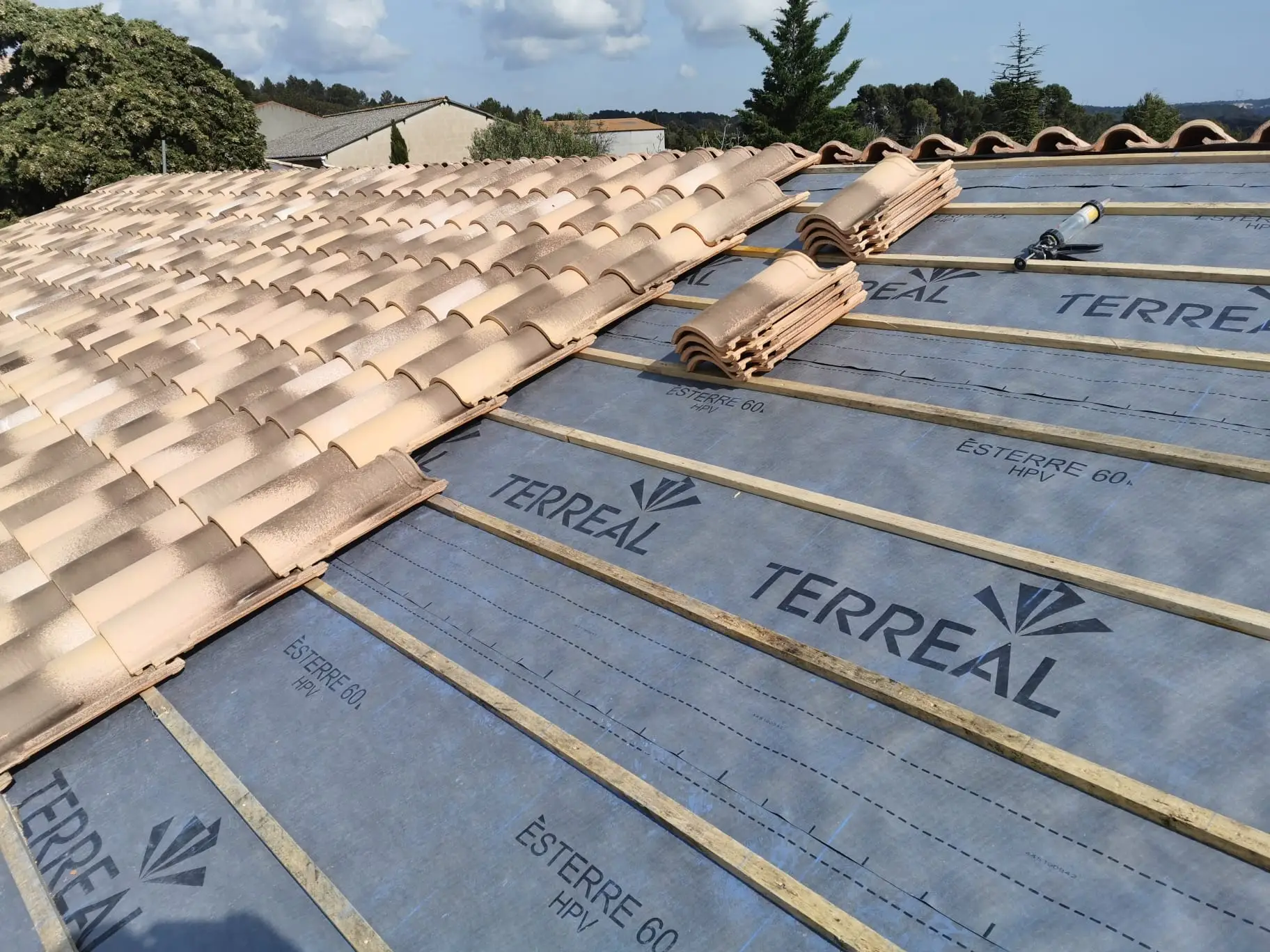
This is where it makes the most sense. An underlay catches the water and powder snow that get under the tiles in strong wind and carries them down to the eaves. Many older roofs in this valley have none — which explains problems that are invisible from outside, particularly after wet and windy spells.
Do tiles really freeze?
It is not the tile that freezes, it is the water it has absorbed. A sound, dry tile takes cold without difficulty. A tile kept damp by moss or by poor ventilation copes far less well, and its surface delaminates after a few winters.
How often should a roof be maintained here?
More often than on the plain, though no single figure holds for every house. The marker is visual: once the north slope has clearly greened, it is time to look. In this valley that happens considerably faster than it does at Trèbes or Capendu.
A roof in Quillan?
Tell us which way the slope faces and how long you have been seeing something. Here, exposure already explains most of the diagnosis.