
Service 04
Roof cleaning, moss removal and maintenance
Moss does not make a roof dirty. It takes it apart — holding water, swelling in the laps, and eventually forcing the tiles apart. On a house you only see a few weeks a year, all of that happens with nobody watching.
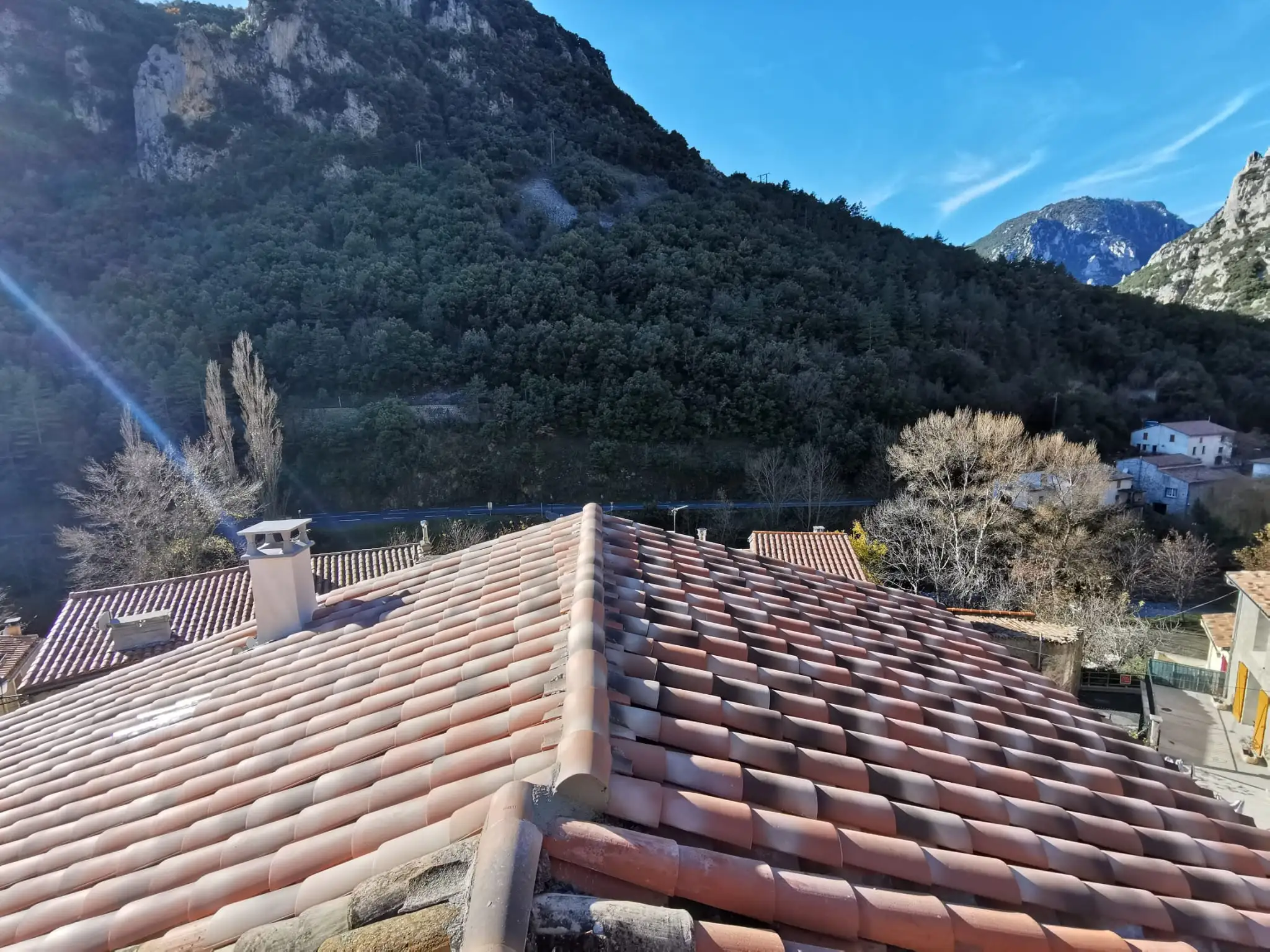
A canal-tiled roof is not watertight in itself. It is watertight because every tile laps another and water never stops moving. Anything that slows the water down or forces the tiles apart attacks that principle — and moss does both.
This is maintenance, not repair. It is planned rather than forced on you, and it is done long before anything leaks. Which is exactly what makes it easy to put off, and expensive to have put off — particularly when the house stands empty for months and there is nobody there to notice the first sign.
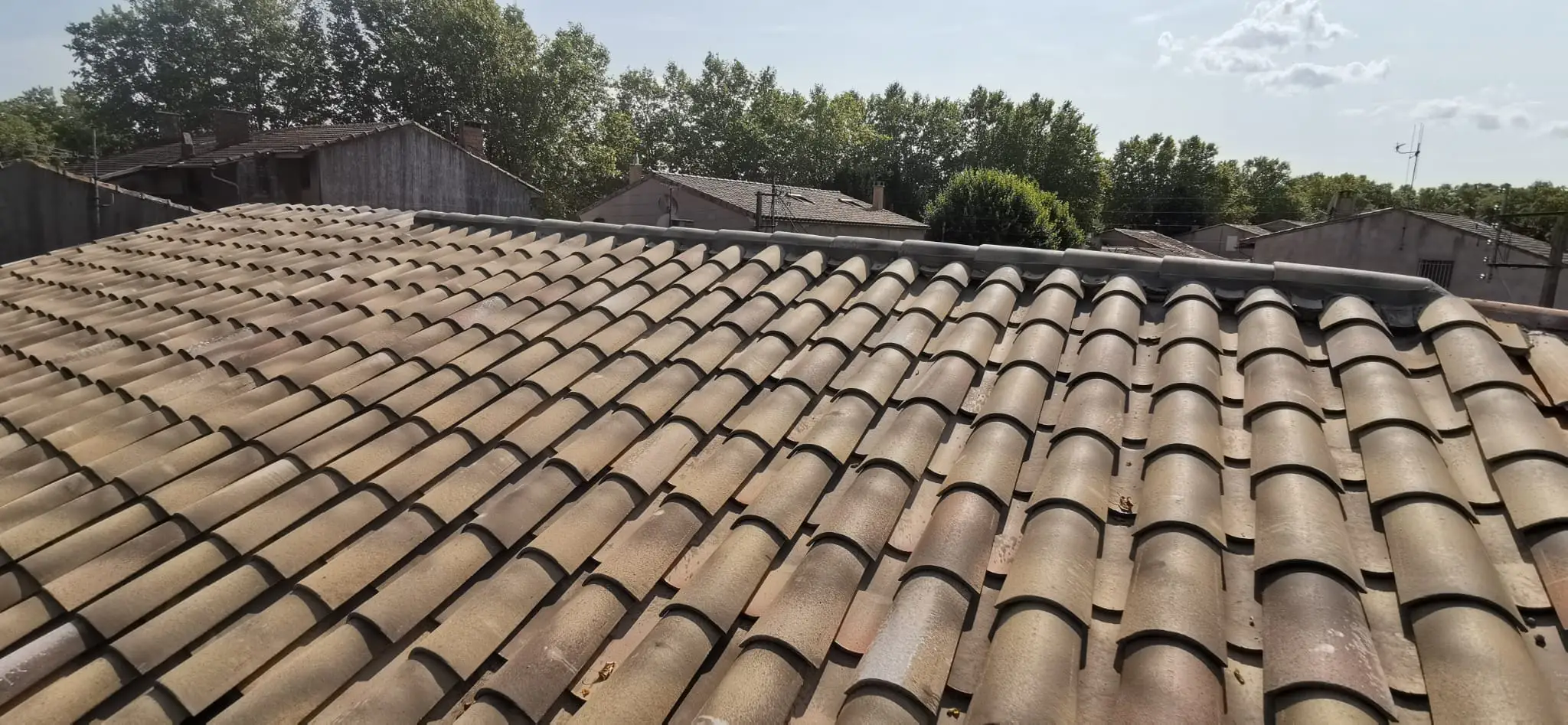
The mechanism
What moss actually does to a roof
A clay tile is porous. Dry, it takes up a little water and gives it back at the first sun; that is its normal cycle and it has coped with it for decades. A tile under moss never dries: it stays damp permanently, including through the spells when it ought to be breathing.
At the first frost, that trapped water expands. It happens again every winter, and that — not the cold itself — is what delaminates the surface of a frost-damaged tile.
The second effect is mechanical and faster. Moss establishes itself in the lap, where two tiles cross. It swells with every downpour, shrinks back, swells again. Across a whole course, that movement eventually forces the tiles apart and opens a way in for water, without a single tile being broken.
- The north slope goes first: it dries more slowly and stays wet for longer.
- A tree nearby accelerates everything — it brings shade, damp and debris together.
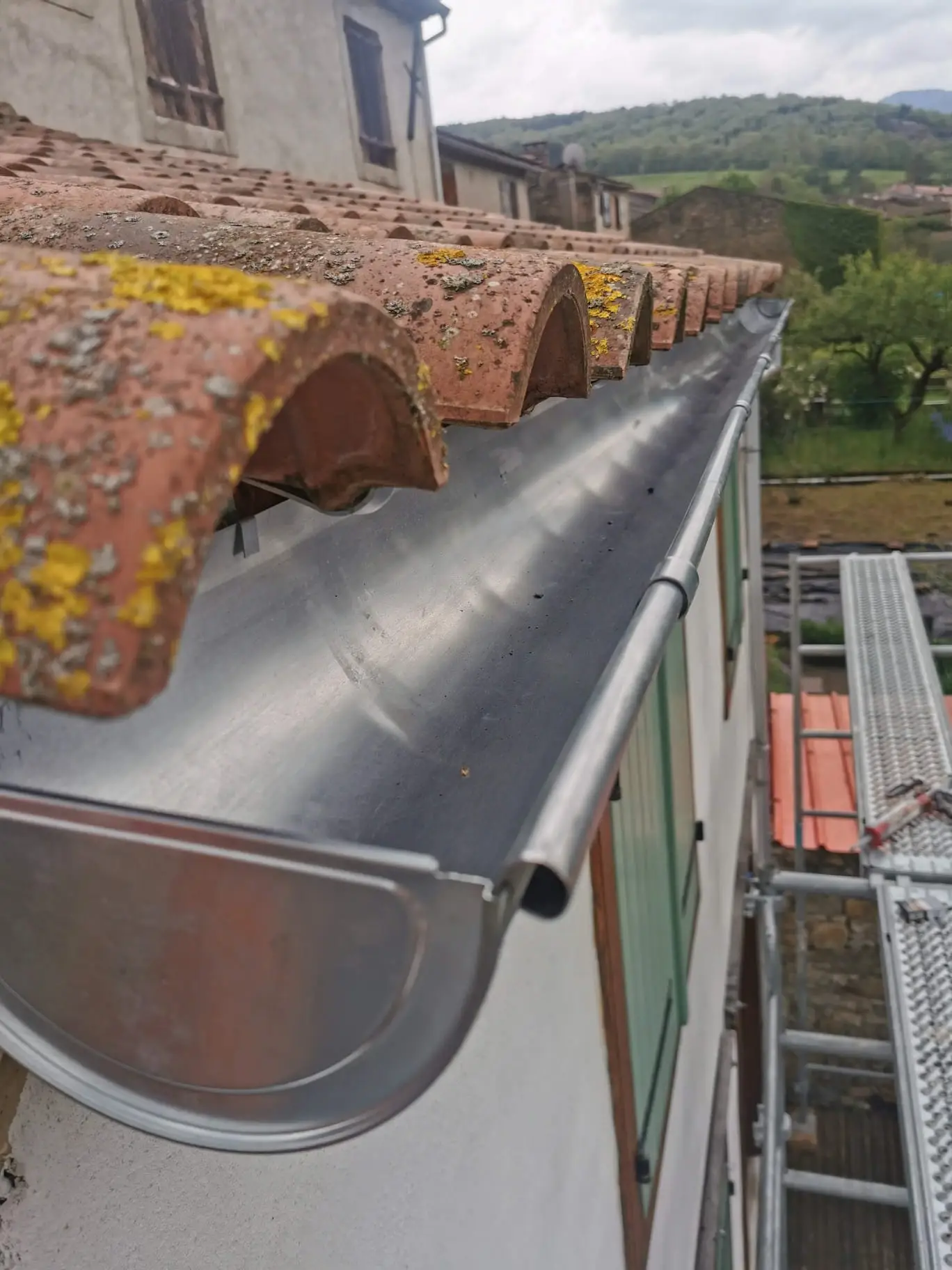
- Moss that is stripped off has to be taken away, not left: it ends up in the gutters and blocks them.
How it goes
What maintenance actually covers
The cleaning is only part of it. The value is in what gets looked at while someone is up there.
-
Looking, before anything else
The first thing is to go up and look. Slipped or cracked tiles, a loose ridge, a split flashing, an open verge: that survey shapes everything after it, because there is no point cleaning a covering that needs rebuilding.
-
Clearing the rainwater goods
Gutters, box gutters, outlets and downpipes. That is where everything falling on the roof ends up, and it is the item that causes the most invisible damage when it is neglected.
-
Cleaning the covering
Moss, lichen and deposits are taken off the surface and out of the laps. The method depends entirely on the state of the tiles: an old covering that is already fragile is not treated like a recent one, and the pressure used is not the same.
-
Rinsing and taking it away
Everything loosened has to come off the roof and out of the outlets. Moss stripped and left where it falls blocks the gutters at the first rain, and the cure becomes the problem.
-
Treatment, where it suits
A water-repellent treatment can be applied after cleaning to slow moss coming back. It does not suit every covering and it never replaces maintenance: it is a decision taken once the roof has been seen, not before.
-
Telling you what was found
The most useful part of maintenance is often the report: what is sound, what will hold for a few more years, and what will need work. This matters far more when you are not there — a photograph and a plain explanation are the only way you will know.
A house that stands empty
The particular problem of a second home
A roof does not fail suddenly. It gives signals for months — a green north slope, a gutter that has started to overflow, a ridge tile out of line — and every one of those signals needs somebody standing in the garden to be noticed. A house occupied three weeks a year has nobody in the garden.
That is why damage found in an empty house is nearly always found late. The ceiling has already moved, the insulation is saturated, and what would have been an afternoon’s work has become a room. The cost of an infiltration grows with how long it lasts, not with how big it looked at the start.
In the Aude, autumn concentrates both trials: falling leaves fill the outlets, and the Mediterranean storms arrive straight afterwards with a month of rain in a few hours. A roof checked before that period gets through the winter. A roof checked afterwards has already taken the consequences.
- After the leaves fall, before the autumn rains — the single most useful moment.
- After any notable gale, to check the verges and the ridge.
- Before a sale or a purchase, so you know what you are selling — or buying.
What people assume about moss removal
- What people assume Moss damages tiles.
- What actually happens It does not attack them, it holds water against them. That permanent damp sets up the following winter’s frost, and bursts tiles that are already cracked.
- What people assume A clean roof is a sound roof.
- What actually happens Not necessarily. A slope cleaned but still shaded and poorly ventilated will be covered again within two years. What matters is drying time, not appearance after cleaning.
What says maintenance is due
- A mat, not a film A green trace is normal. Moss you can push a finger into means a slope that no longer dries at all.
- Gutters overflowing Often loaded with moss washed off the roof. The overflow stains the façade and eventually damages it.
- A sharp difference between two slopes A green north and a clean south is normal. A green south as well is a ventilation problem.
- Tiles starting to delaminate The moss has done its work. At that stage cleaning alone will no longer be enough.
How maintenance is done
- We look first at why it grows A rubbing branch, a sunless slope, blocked ventilation. Cleaning without treating the cause does not last two years.
- We clear by hand and brush No pressure washer. Slower, and the only method that does not shorten the life of the tile.
- We flush the rainwater goods Gutters, outlets, downpipes. Moss washed off the roof ends up there, and that is where it blocks.
- We check the ventilation Vent tiles at the eaves, closure at the ridge. A roof that breathes dries, and a roof that dries stops going green.
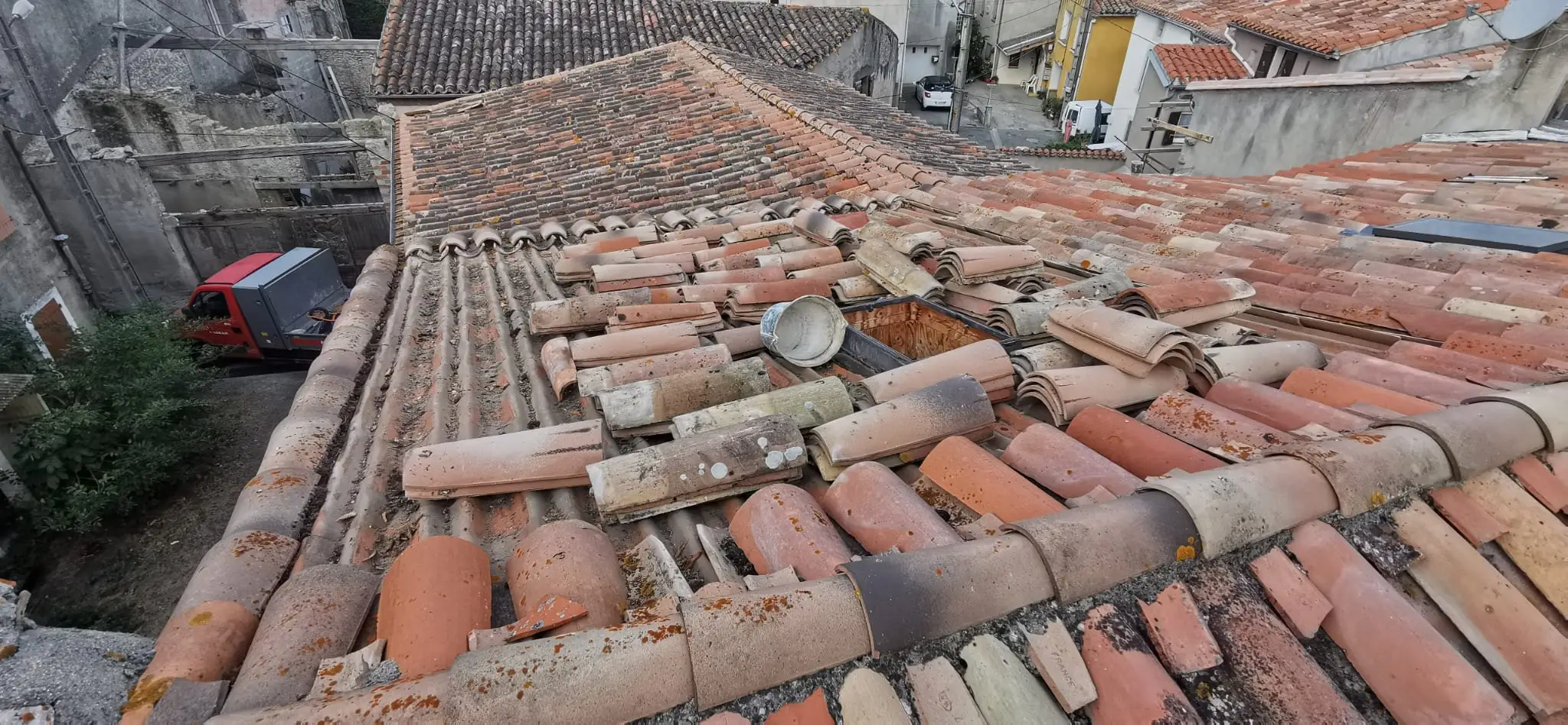
- We find what has suffered underneath Moss hides things. Once cleared, cracked tiles and porous bedding appear.
On site
The state of a covering, honestly
These show real conditions on MBS Roofing Work South France sites. We have no photograph of the cleaning operation itself, and we would rather say so than borrow one.
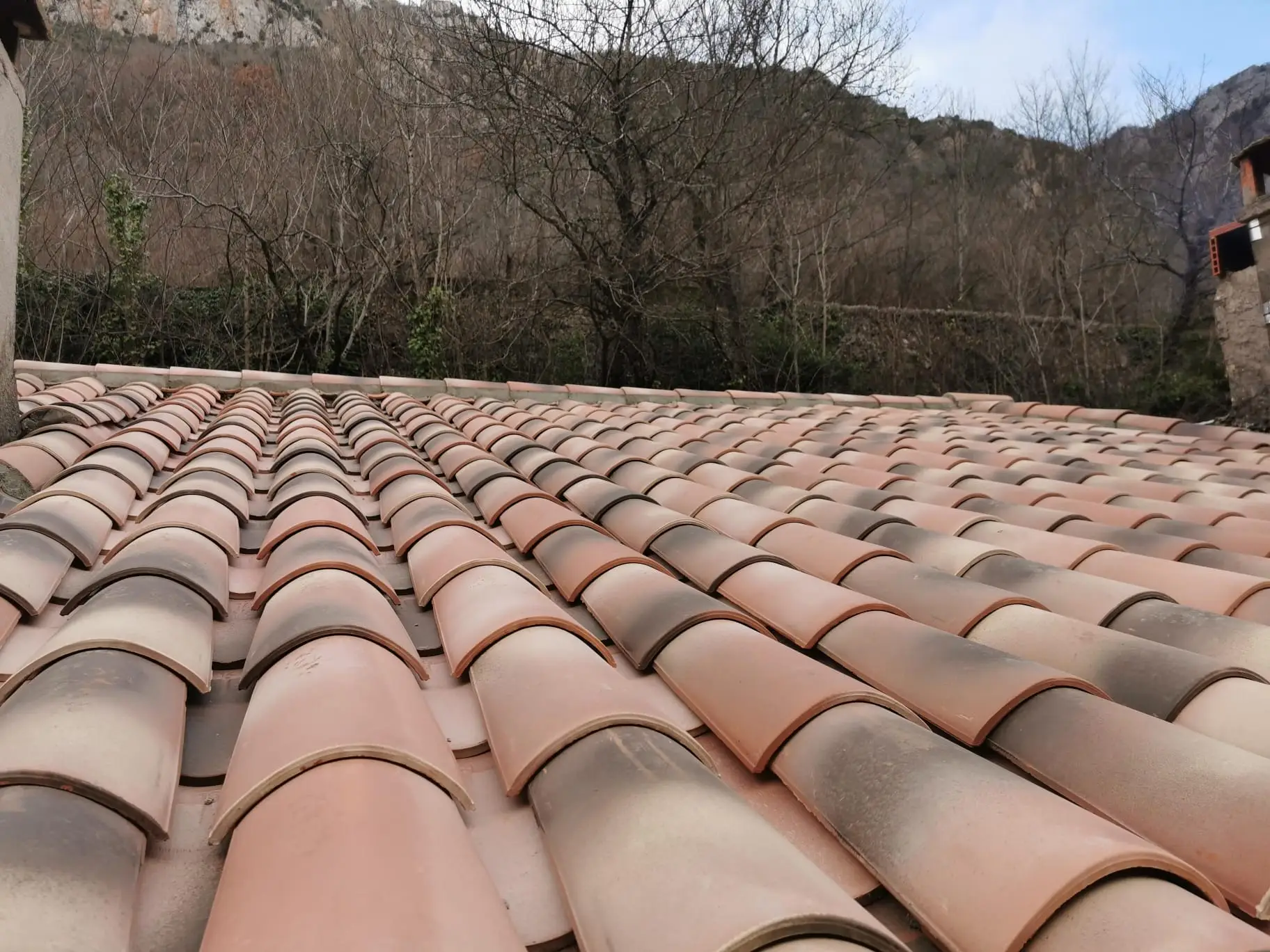
What maintenance lets you get ahead of
- Roof repairs and tile replacement Moss is behind a good share of slipped tiles. Whatever is spotted during a clean gets put right at the same time.
- Zinc work, guttering and box gutters Clearing the outlets is part of maintenance. Replacing them, once they are tired, is zinc work.
- Ridges, verges, closures and chimney flashing These are the first details anyone checks on going up, and the first to show their age.
Where we work
Maintenance is planned work, which makes it straightforward to arrange even when you are not in the country. Our four areas cover the Haute-Vallée de l’Aude, the Minervois and the Alaric, the Corbières, and the Montagne Noire and Cabardès.
Minervois & Alaric Haute-Vallée de l’Aude Corbières Montagne Noire & Cabardès
Common questions
Does moss really damage tiles?
Yes, in two distinct ways. It stops the tile drying, which leaves water in its pores when the frosts come and eventually delaminates the surface. And it establishes itself in the lap between two tiles, where it swells and shrinks with every downpour until it forces them apart. The second effect is faster, and it opens a way in for water without breaking anything.
How can I keep an eye on a roof I only see a few weeks a year?
You cannot, from a distance — which is the honest answer. What works is having it looked at on a planned basis rather than waiting for a signal that nobody is there to see, and being told what was found rather than simply told it was done. A photograph of a ridge or a gutter is worth more than any reassurance.
How often should a roof be cleaned?
There is no figure that holds for every roof. A covering in open sun can go several years without needing anything; the same roof under a tree covers over in one season. The useful marker is visual: once the north slope has clearly greened, it is time to look.
Should a water-repellent treatment be applied?
That is decided once the covering has been seen, not before. It slows moss returning but does not suit every tile, and it never replaces maintenance. In most cases what matters far more is that the outlets stay clear.
Is pressure washing dangerous for old tiles?
It can be, which is why the method is chosen according to the state of the covering. An old, already porous tile will not take what a recent one shrugs off. Badly judged pressure strips the surface of the tile and accelerates precisely what you were trying to prevent.
Can you work on the house while I am not there?
That is the whole point of maintenance: it needs no access indoors and it is arranged in advance. What matters is that someone reports back to you on what was found — in English, and in terms that mean something.
Have the roof looked at
Tell us the age of the covering, which way it faces, what trees are near it, and whether any gutters overflow. Write in English; that is entirely fine.