
Limoux · 11300
Roofer in Limoux
The largest town in the Haute-Vallée, and its densest old centre. Here the question is not only what the roof needs — it is how anyone gets to it.
Limoux sits on both banks of the Aude, where the valley widens before climbing south. Its old centre is built around the arcaded Place de la République, in a tight fabric of narrow streets and adjoining houses.
That fabric defines the work. A roof here is rarely on its own: it touches the neighbour’s, runs up against a wall standing proud, and sometimes shares a chimney stack. And the street serving it is not always the width of a lorry.
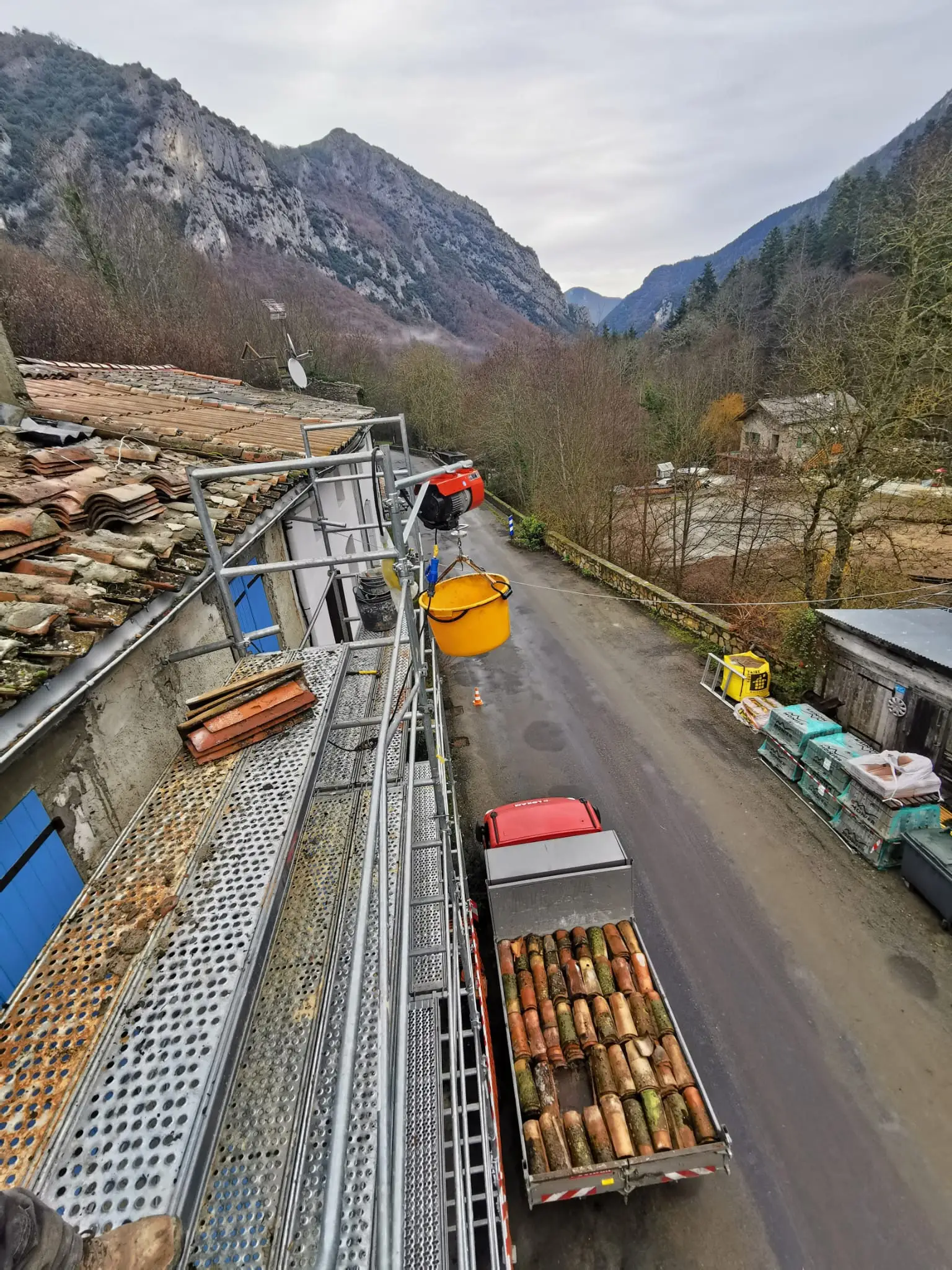
The ground
What Limoux roofs are like
Three features of the building stock, and what each changes about the work.
-
Coverings that touch
In a continuous old centre, the covering does not stop at the property line: it joins. Those junctions — flashings against a party wall, shared stacks, changes of level between two roofs — account for most infiltrations, and they involve two owners rather than one.
-
Access decides the job
Narrow street, one-way system, pedestrian square: putting up a scaffold and delivering pallets often needs permission to occupy the public highway, sometimes a traffic order. Ordinary logistics, but arranged beforehand rather than on the day.
-
Uneven heights
The stock in Limoux mixes periods and scales. A three-storey building stands next to a low house, which multiplies the steps, the walls standing proud, and the details that have to be weathered.
What people assume about a town house
- What people assume A terraced house has less roof, so fewer problems.
- What actually happens It has less area but far more awkward parts: two wall junctions instead of two free verges, often a valley, and a shared stack. And it is the awkward parts that leak, not the slopes.
- What people assume A quote can be done from photographs.
- What actually happens Photographs can frame a problem, and that already helps. They cannot price a job without someone having seen the access, the state of the deck under the tiles, and the room available for a scaffold.
On a house in central Limoux
- The junction with next door From the street, look at the line where the two roofs meet. It should be clean and even.
- Marks high on the walls A ring on an upstairs ceiling near the party wall almost always points to a flashing rather than a tile.
- The gutter on the elevation On a narrow street it discharges at head height. An overflow gets noticed quickly — which makes it a useful indicator.
- Access, before anything Measure the street width and work out where a skip could stand. It is the first question you will be asked.
What we check before pricing
- Measuring the street Usable width, façade height, where the skip can stand. That survey determines the type of scaffold and its cost.
- Opening the party-wall junction We lift a few tiles either side. A flashing is judged from underneath, never from the street.
- Probing the boarding from below From the loft, before even going up. A soft board can be felt by hand and steers the rest of the visit.
- Checking the valley If there is one: soaker laps, the state of the metal, and any mastic — which always signals an emergency repair.
- Verifying the downpipe size We compare the roof area collected against the pipe section. On an extended house it is rarely recalculated.
Where it sits
Limoux in the valley
The four towns of the Haute-Vallée, running north to south along the Aude, in their real order.
Positions to scale · areas approximate · rings at 10, 20 and 30 km from Carcassonne.
Towns
The other towns in the valley
Each has its own page, because each raises different questions.
Services
Our services in Limoux
All six, without distinction. On this kind of stock, flashings and junctions between roofs come up more often than anywhere else.
What we cover
Limoux and the rest of the valley
Limoux is the northern gateway to the Haute-Vallée: the valley climbs from here up to Couiza, Espéraza and Quillan. We work along that whole line, and the distances between those towns are short.
The buildings, though, change fast. The tight centre of Limoux has very little in common with the industrial-era blocks of Espéraza, twenty kilometres upstream.
Common questions in Limoux
Do I need permission to put up scaffolding in a Limoux street?
In the old centre, very often. Occupying the pavement or the road requires a permit from the mairie, and a narrow street may need a traffic order as well. It is applied for in advance: it is exactly the sort of delay that pushes a job back if it is left to the last minute.
My roof adjoins next door — who pays for the junction?
It depends where the boundary actually runs and what the detail is. Technically, a junction against a party wall is a flashing and is treated as one. Legally, it is far better to establish who owns what before the work starts — that is a conversation between neighbours, not a technical question.
Do you work in the outskirts and the surrounding hamlets?
Yes. Limoux is not only its centre, and detached houses on the edges raise much simpler questions: open access, independent roofs, no shared walls. Those are usually the quickest jobs to organise.
A roof in Limoux?
Say whether you are in the old centre or on the outskirts: it changes how the job is organised far more than the work itself does.