Choose what you can see above, then narrow it down: the answer will appear here.
What it probably is Deal with it now
Very probably a flashing
The junction between the covering and anything vertical — a chimney stack, a party wall, a dormer — is the most common cause of a long-standing leak. It takes both the building’s movement and the roof’s concentrated run-off, and it fails with nothing showing from the ground.
What you can check From the street, look at the junction: a flashing patched with mastic stands out by its colour, and it is nearly always the sign of an emergency repair that did not hold.
The related service
What it probably is Deal with it now
The entry point is somewhere else
Water almost never falls directly below where it got in: it runs along a rafter or across the underlay, crosses the loft floor, and comes out where it can. A stain in the middle of a room therefore often starts several metres higher up.
What you can check Go into the loft on a wet day with the light off. Daylight shows, running water can be heard — and the marked timber tells you which way the water ran.
The related service
What it probably is Deal with it this season
A question of headlap, or of a verge
A leak that only shows in wind identifies an exposure, and therefore one side of the house. The mechanism is nearly always the same: wind drives water under the tiles where the headlap is too short, or gets beneath a loose verge. Without wind the same roof stays dry.
What you can check Note the wind direction on the day it happens. It is the most useful thing you can tell us: it halves the search.
The related service
What it probably is Deal with it now
The wind found a grip
Wind almost never breaks a tile in the middle of a slope: it finds nothing to hold. It lifts from an edge — a loose verge, a ridge that has moved, a tile already displaced — and then spreads. The fallen tile is the symptom; the grip is the problem.
What you can check Look at the ridge line from the street, at a distance: it should be dead straight. Any step in it means bedding that has let go.
The related service
What it probably is Deal with it this season
Probably frost, or a tile at the end of its life
A tile that cracks without a gale has usually taken water and then frost: water held in a hairline crack freezes, expands, and opens the crack a little further every winter. In the Haute Vallée and the Montagne Noire, that is the dominant wear mechanism.
What you can check Pick the piece up. A tile splitting into flakes is delaminating: it cannot be repaired, and it announces others on the same slope.
The related service
What it probably is Deal with it this season
This is no longer a repair
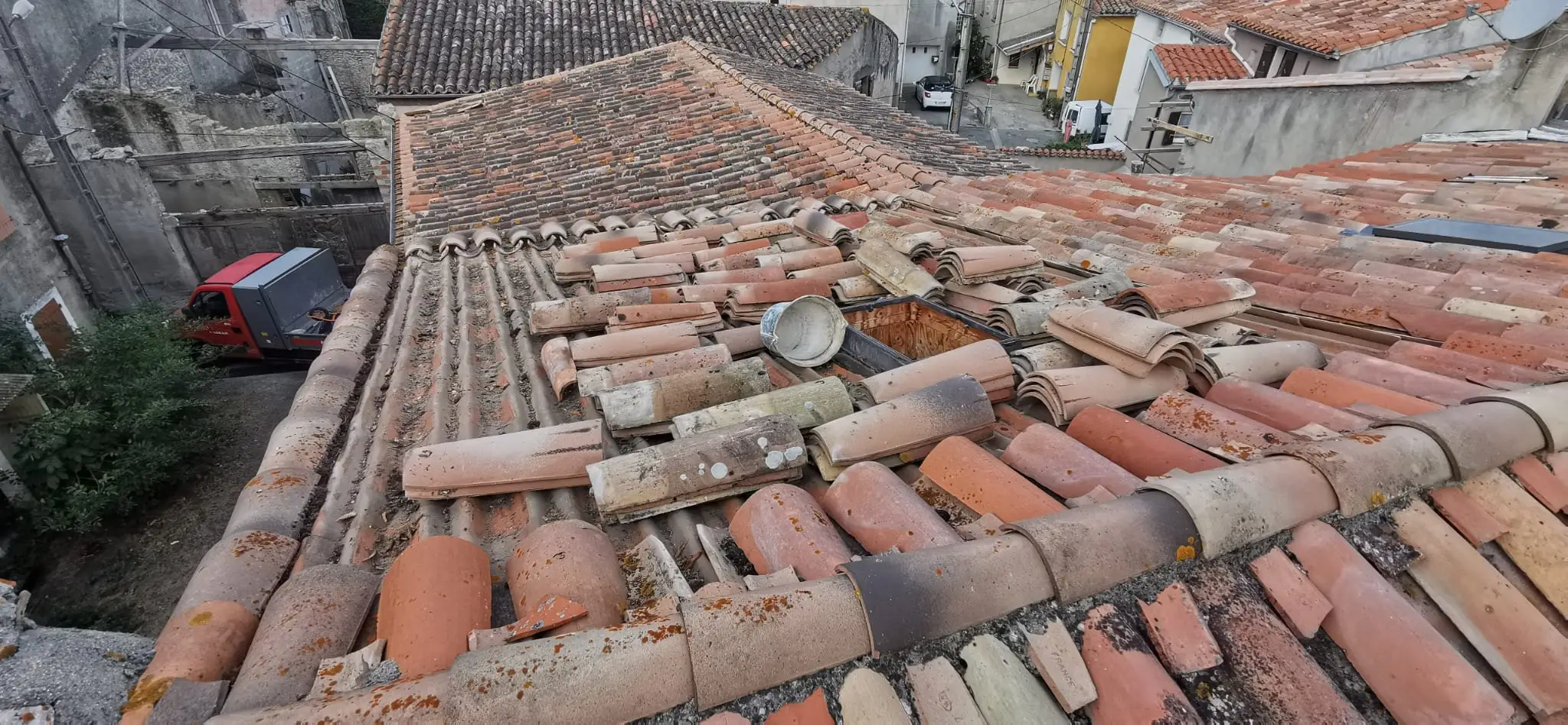
Tiles that keep coming off the same slope stop being a tile question and become a covering question: either the deck has moved, or the clay has reached the end of its life on that exposure. Replacing them one by one means paying for the same visit several times.
What you can check Compare the two slopes from the street. If one deteriorates and the other does not, it is exposure; if both go together, it is the age of the covering.
The related service
What it probably is Keep an eye on it
Normal, but worth watching
A north-facing slope dries slowly: moss settles on them everywhere, and a green film is not alarming. What matters is thickness. A mat you can push a finger into holds water against the clay permanently, and sets up the following winter’s frost.
What you can check Check whether the gutters are filling: moss washed off the roof blocking the outlets is the first measurable effect, and the most expensive.
The related service
What it probably is Deal with it this season
A ventilation problem, not a moss problem
A south slope going green is a slope that no longer dries, and that does not come from the climate. The cause is nearly always under the covering: a missing or blocked air gap, clogged vent tiles, a crushed ridge closure. The roof breathes on one side only, or not at all.
What you can check From the loft, look for daylight at the eaves and at the ridge. If air neither enters nor leaves, the moss will return whatever the cleaning.
The related service
What it probably is Deal with it this season
The moss has done its work
Once tiles begin to delaminate under the moss, cleaning alone is no longer enough: the clay has lost its surface, it absorbs water, and every frost opens it further. That is the point at which the covering is assessed rather than cleaned.
What you can check A pressure washer would make it worse: it strips the fired surface and opens the porosity further. It is the one thing not to do.
The related service
What it probably is Deal with it this season
The fall has been lost
A gutter overflows in its middle when it no longer drains: either a bracket has given way and the line sags, or the fall was never sufficient. Held water is heavy, and its weight pulls out the next brackets — the fault worsens on its own.
What you can check After rain, check whether water is sitting in the gutter. A properly hung gutter is empty a few minutes after the shower stops.
The related service
What it probably is Deal with it this season
The downpipe is saturating
It is not the gutter at fault but the pipe taking the water away. A wide gutter connected to a narrow downpipe backs up at its ends as soon as the flow exceeds what the pipe can take — and the water ends up in the wall instead of the ground.
What you can check Listen to the downpipe during a shower. An irregular gurgle points to a partly blocked pipe, usually at a bend.
The related service
What it probably is Keep an eye on it
The system is undersized
A system that copes eleven months of the year can overflow three times in September. Mediterranean episodes drop in an hour what an ordinary month brings, and a gutter is sized for those — not for everyday rain. It is common after an extension, when the area collected has grown without the system being recalculated.
What you can check Watch during the storm, not after. Where the water comes out and where it sits shows in thirty seconds and cannot be guessed later.
The related service
These are pointers, not diagnoses. A roof is judged by lifting tiles: two very different causes often produce the same ceiling stain, and only a visit settles it.