
Area 01
Roofer in the Minervois and the Alaric
Plain, wind and vines. This is the most wind-exposed of all the areas we work in — and it shows on the roofs.
The Minervois and the Alaric ridge sit in the corridor between the Montagne Noire and the Corbières. That corridor is exactly why the wind behaves as it does: air coming off the Atlantic funnels through it and accelerates. The Cers blows harder and more often here than anywhere else in the department.
The buildings are those of a wine-growing plain: tight villages, maisons de maître, and cellars and outbuildings with long, shallow-pitched roofs. Three villages in this area — Olonzac, Oupia and Azillanet — are just over the border in the Hérault.
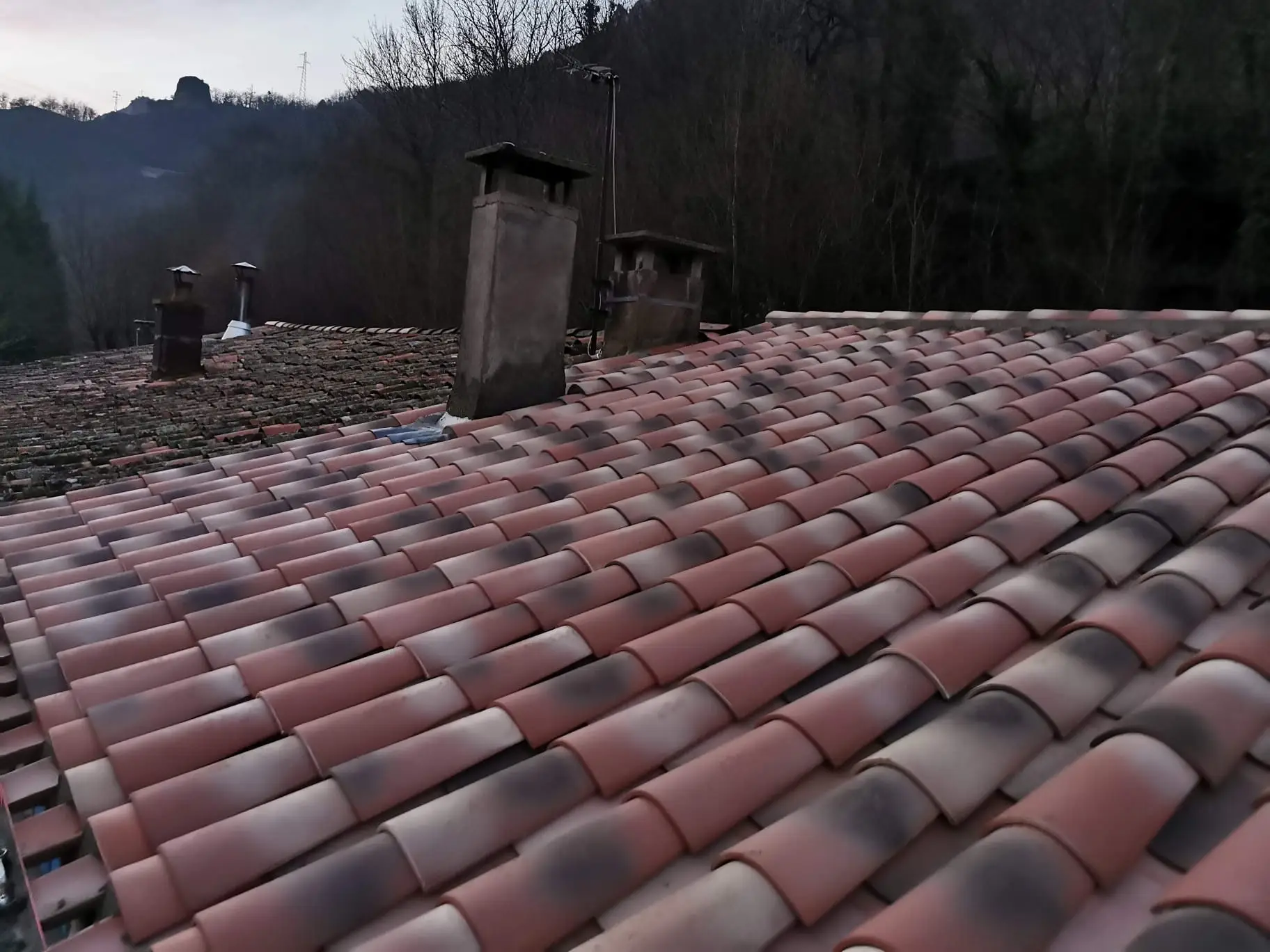
The ground
What the area does to roofs
Three characteristics of this landscape, and what each one does to a tiled covering.
-
The Cers, head-on
A westerly that regularly passes 80 km/h in the corridor. It looks for the verges, gets under the first course that gives, and lifts outwards from there. Verge tiles and verge mortar work harder here than anywhere.
-
Long, shallow slopes
Cellars, barns and wine buildings present large roof areas at a shallow pitch. Water leaves them slowly, the lap between tiles matters that much more, and the wind has a great deal to take hold of.
-
Drought, then violence
The climate alternates long dry spells with the autumn Mediterranean storms. Mortars move with that swing, and outlets sized for ordinary rain fill in minutes.
Three assumptions about roofs in the Minervois
- What people assume A tile blown off means the roof needs replacing.
- What actually happens Almost never. A tile that leaves is the symptom of something for the wind to grip — a loose verge, a ridge that has moved, a course with too little lap. You treat the grip, not the tile. A full re-roof is decided on the state of the deck, not on one gale.
- What people assume A big barn roof is treated like a house roof.
- What actually happens Technically yes, but the priorities change. On a long shallow slope water moves slowly: headlap and downpipe sizing matter far more than on a small steep roof, where it all runs off quickly anyway.
- What people assume After a windy spell you can see the damage from the ground.
- What actually happens You see what fell. You do not see what moved — and that is what matters. A tile shifted by two centimetres stays put, goes unnoticed, and lets water in at the next rain.
What you can check yourself after a blow
- The ridge line From the street, at a distance, it should be dead straight. Any step in it points to bedding that has let go.
- The foot of the walls Fragments of clay on the ground came from above. Pick them up: they tell you which side of the house to look at.
- The west-facing verges That is where the wind arrives. The edge course should be even, with no tile standing proud and no crumbling mortar.
- The loft, on a wet day Lights off. Daylight shows, running water can be heard. It is the most effective check there is, and it costs nothing.
What we look at on arrival
- The windward verges The west-facing edge course first: that is where the wind takes hold of a roof, and almost always where trouble starts.
- The ridge bedding We sound the mortar by hand. Bedding that rings hollow has already let go, even if nothing has moved yet.
- The headlap of the courses On long shallow roofs this is what makes them watertight. We measure rather than judge by eye.
- Downpipe sizing A large roof concentrates a great deal of water in minutes during an autumn episode.
- The deck, under anything that moved We lift tiles. A tile displaced two winters ago has let water through, and the timber underneath says so.
Where it sits
The area, within the territory
The relative position of the four areas. The others are clickable — it is often the neighbouring one you were after.
Positions to scale · areas approximate · rings at 10, 20 and 30 km from Carcassonne.
- Minervois & Alaric The area MBS Roofing Work South France works from, running from the Aude plain to the lower slopes of the Alaric, and across into three villages in the Hérault.
- Haute-Vallée de l’Aude From Limoux up through the gorges towards Quillan — a valley of stone villages where roofs take a beating.
- Corbières Villages of real character with old roofs, where renovation has to respect what is already there.
- Montagne Noire & Cabardès Higher, wetter and more exposed — roofs age differently up here than they do down on the plain.
Villages and towns covered in this area
- Lézignan-Corbières
- Trèbes
- Argeliers
- Saint-Nazaire-d'Aude
- Rieux-Minervois
- Canet
- Olonzac (34)
- Ginestas
- Caunes-Minervois
- Capendu
- Bize-Minervois
- La Redorte
- Puichéric
- Peyriac-Minervois
- Pépieux
- Azille
- Laure-Minervois
- Conilhac-Corbières
- Cruscades
- Malves-en-Minervois
- Barbaira
- Douzens
- Siran (34)
- Mirepeisset
- Badens
- Paraza
- Marseillette
- Ventenac-en-Minervois
Show the other 41 villages in this areaCollapse the list
- Trausse
- Homps
- Pouzols-Minervois
- Villedaigne
- Mailhac
- Rustiques
- Sainte-Valière
- Aigues-Vives
- La Livinière (34)
- Roubia
- Escales
- Félines-Minervois (34)
- Castelnau-d'Aude
- Tourouzelle
- Aigues-Vives (34)
- Cesseras (34)
- Floure
- Argens-Minervois
- Saint-Couat-d'Aude
- Azillanet (34)
- Montbrun-des-Corbières
- Comigne
- La Caunette (34)
- Aigne (34)
- Oupia (34)
- Blomac
- Monze
- Montouliers (34)
- Agel (34)
- Saint-Frichoux
- Raissac-d'Aude
- Beaufort (34)
- Villefloure
- Roquecourbe-Minervois
- Saint-Jean-de-Minervois (34)
- Minerve (34)
- Vélieux (34)
- Rieussec (34)
- Fajac-en-Val
- Boisset (34)
- Mas-des-Cours
Services
What we do here
All six services, without distinction: the area does not change the trade, it changes what fails first.
What we cover
Why being local matters
This is the area MBS Roofing Work South France works from, and where the distances are shortest. That is not a sales line: getting a scaffold up, having pallets of tiles delivered, and being able to come back tomorrow if the wind gets up are logistical questions, not sentimental ones.
Being close to the Hérault border is not an obstacle: Olonzac, Oupia and Azillanet are nearer to us than several Aude villages are.
Common questions about this area
Does the wind really damage roofs more here?
It does not damage them differently — it damages them more often. The mechanism is always the same: the wind looks for a hold under a verge or a displaced tile. But in the corridor between the Montagne Noire and the Corbières it turns up far more frequently and far harder. Verges and ridges need particular attention here.
Do you work in the Hérault?
In three neighbouring villages: Olonzac, Oupia and Azillanet. They belong to the same everyday area and sit a few kilometres from the rest of the sector. Beyond those, we would rather say so than waste everybody’s time.
Are large outbuilding roofs treated like a house?
Technically yes, but the scale changes the priorities. On a long, shallow roof the lap between tiles and the sizing of the rainwater goods matter more than on a small steep slope, where the water leaves quickly regardless.
A roof in the Minervois or on the Alaric?
Tell us where it is and what you can see. This is the area we work from — we know the access, the wind and the narrow streets.