
Espéraza · 11260
Roofer in Espéraza
Two kilometres separate Espéraza from Couiza, and a century separates their buildings. Hat-making left roofs here on an entirely different scale.
Espéraza owes its shape to its industrial past. Hat-making employed much of the valley, and it left behind a building stock you will not find in the neighbouring villages: tall narrow blocks, former workshops, converted factory buildings.
That is not a heritage footnote, it is a technical fact. A former workshop does not have a village house’s roof: the spans are longer, the slopes larger, the structures different, and the rainwater goods have to take areas of a completely different order.
The ground
What the scale changes
Three direct consequences of Espéraza’s building stock, on a tiled covering.
-
Far larger roof areas
A workshop slope can be several times a house’s. That changes everything downstream: how much water has to be carried away, how box gutters are sized, and the cost of a re-roof, which is worked out by the square metre.
-
Tall, narrow blocks
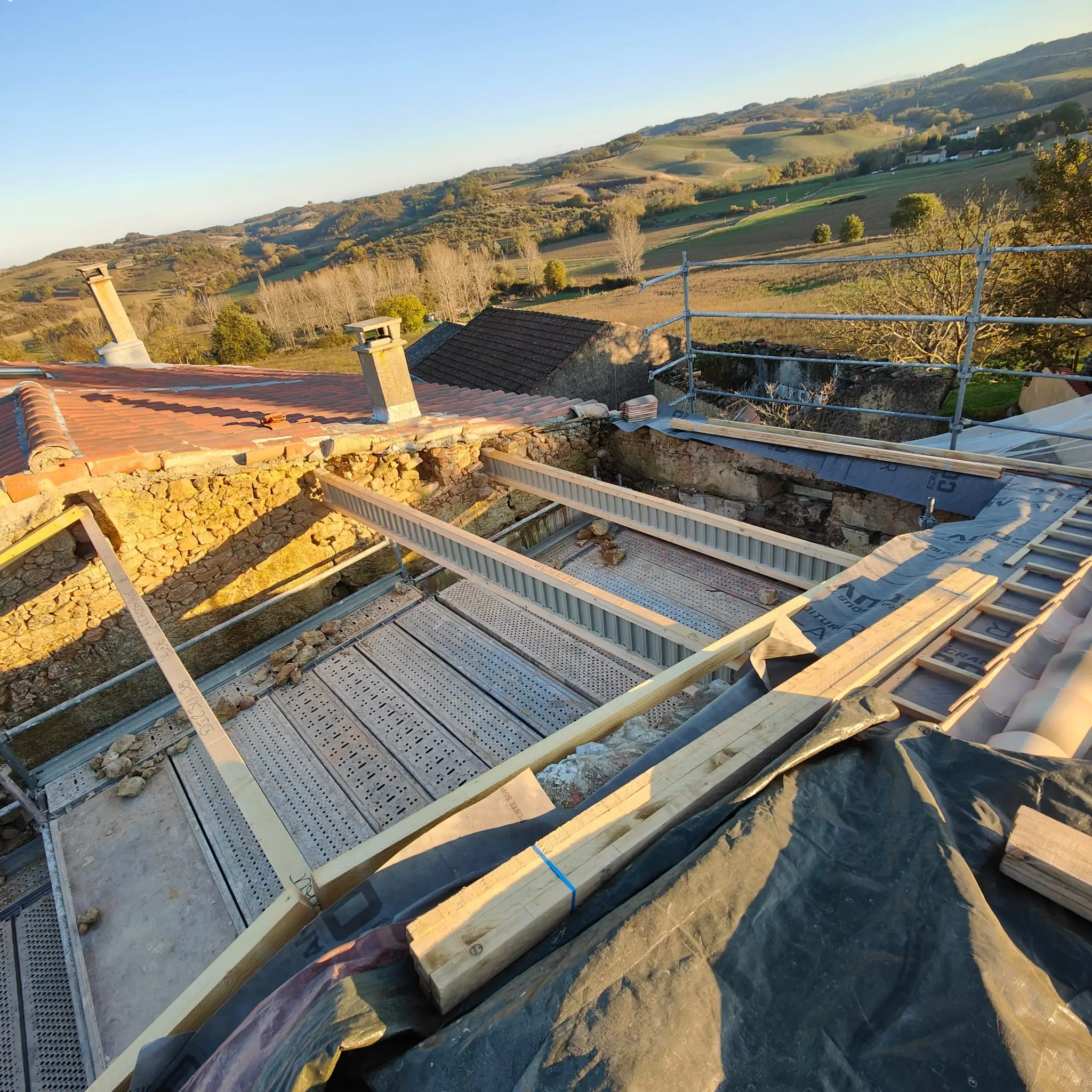
The housing of that period includes buildings of several storeys on a small footprint. Height complicates access, requires a full scaffold where a low house would not, and multiplies downpipes on a narrow façade.
-
Box gutters rather than gutters
Large buildings often use box gutters set behind a wall or a cornice rather than a gutter hung on brackets. More discreet — and far more treacherous: a saturated box gutter backs up inwards, under the tiles, showing nothing at all on the façade.
What people assume about a large building
- What people assume A sagging roof is a tile problem.
- What actually happens Never. A dip visible from the street comes from a purlin, a truss or a bearing — that is, from the frame. Tiles only follow the shape they are given.
- What people assume A large roof costs proportionally more.
- What actually happens Not necessarily: work per square metre is often simpler on a large regular surface than on a small roof full of awkward details. It is the junctions that cost, not the square metres.
- What people assume An industrial building is treated like a shed.
- What actually happens Many of these volumes are former stone workshops, with traditional timber frames and bearings built into the masonry. Nothing like a steel structure: they are old wide-span buildings, and they are diagnosed as such.
On a wide-span building
- The ridge line, from a distance On a long roof, a sagging frame is visible to the naked eye from across the street. It is the simplest check there is.
- Bearings on the walls The end of a purlin bedded into an old wall is a classic rot point, and invisible from inside.
- Large surfaces facing the wind The bigger the surface, the more grip the wind has. Verges and ridge need more attention here.
- The rainwater goods A large roof collects a lot of water very fast in a storm. Downpipes have to be sized for that.
What we check before pricing
- Surveying the frame from the loft Span, truss spacing, purlin sections. On a wide-span building the diagnosis starts underneath, not on top.
- Probing the purlin ends With a spike, into the masonry. It is the classic rot point on these buildings, and the only one that is completely invisible.
- Stripping a test area On a large surface you do not strip everything to find out. A few well-chosen square metres are enough to judge the deck.
- Testing the verge fixings By pulling on them, by hand. The larger the surface, the harder the wind pulls, and the more a weak fixing costs.
- Calculating the area collected We compare the square metres of roof against the actual downpipe sections. On these volumes the gap is often considerable.
Where it sits
Espéraza in the valley
The four towns of the Haute-Vallée, running north to south along the Aude, in their real order.
Positions to scale · areas approximate · rings at 10, 20 and 30 km from Carcassonne.
Towns
The other towns in the valley
Each has its own page, because each raises different questions.
Services
Our services in Espéraza
All six. On this kind of stock, zinc work and box gutters take a place the other towns in the valley do not give them.
What we cover
Espéraza and Couiza: two kilometres, two worlds
The two towns almost touch, and yet they do not raise the same questions. Couiza is a modest, grouped crossroads town; Espéraza inherited industrial volumes and the details that go with them.
We work in both, of course, as well as in Limoux and Quillan. It is the same valley, and the same journeys.
Common questions in Espéraza
Do you work on former workshop buildings?
On their coverings, yes: it is tiled roofing as anywhere else, on a different scale. What changes is the spans, the sizing of the rainwater goods, and the need to examine the structure before deciding anything — a long span does not forgive approximation.
Is a box gutter trickier than a gutter?
Trickier to diagnose, above all. An overflowing gutter can be seen from the garden; a saturated box gutter backs up under the tiles at the foot of the covering and attacks the fascia and the ends of the boarding without leaving a mark on the façade. A great many “roof leaks” are really blocked box gutters.
Does a block need a full scaffold?
In almost every case, yes. Over three or four storeys there has to be safe access along the eaves, a way of getting materials up and the stripped covering down. Erecting it is part of the job, and it weighs more in the budget than it would on a low house.
A roof in Espéraza?
Say what kind of building it is — village house, block, former workshop. In this town that determines everything else.