
Service 03
Roof leaks and urgent repairs
A damp patch on the ceiling tells you where the water comes out. It says almost nothing about where it got in. Tracing that route back is most of the work.
Call and describe it in English. Where the mark is, how long it has been there, and whether it grows while it rains or only afterwards — that is already half the diagnosis.
What you can see
What you can see, and what it usually means
Four descriptions come up again and again. None of them points to where the water gets in, but each sends the search in a different direction.
-
A brown ring on the ceiling
A brown-edged stain means the leak is old or repeated: the water has dried out several times and left behind everything it was carrying. The way in is almost always higher up the slope, often several metres from the mark itself.
-
Water running while it rains, and only while it rains
The route is short and direct — a slipped tile, a broken one, or an open flashing where the chimney meets the roof. This is the easiest case to find, because the fault can still be seen from outside.
-
A damp smell in the roof space, with nothing showing below
The insulation is soaking up the water before it reaches the ceiling. This can go on for months without a mark appearing, while the wet insulation stops doing its job and the timber underneath never dries out.
-
A leak that only shows after a storm, or in a westerly wind
Water only gets through when something drives it: heavy rain, wind across the slope, or a gutter so full it backs up behind itself. This is the hardest leak to reproduce on demand, and the surest sign that a detail has failed rather than the roof as a whole.
In all four cases the useful question is not which tile is broken, but which route the water took to arrive there.
How water travels
Why the stain is almost never under the leak
Under the tiles, water does not fall — it runs. It follows the fall of the slope, and only drops off where something stops it.
Once past the tiles, water meets the underlay, or on an older roof the bare boarding. From there it follows the fall of the slope, works its way round a batten, runs along a rafter, and leaves that surface at the first obstacle it finds: a tear, a poorly lapped joint, a nail, the end of a board. Between the point where it entered and the point where it shows on your ceiling there are often several metres — and sometimes a different room altogether.
That is why a repair carried out directly above the stain fails so often. It treats where the water comes out, not where it goes in. Working back along that route — from the ceiling into the roof space, and from the roof space to the outside — is what roof leak detection actually consists of.
-
Where it gets in
Here, the flashing at a chimney stack. The water crosses the covering without leaving anything visible from the ground.
-
The route
It follows the fall of the underlay, for the whole length of the slope if nothing stops it sooner.
-
Where it drops
A tear, an open lap or the end of a board: the water leaves the underlay and falls into the roof space.
-
The mark you can see
The only part you ever see — and the only part that tells you nothing about the cause.
Here in particular
Two kinds of weather expose these faults here more than any other. The Cers, the westerly wind that sweeps down the Aude valley and across the plain, lifts tiles at the verge and drives rain up under the laps: a roof that is perfectly watertight in still conditions can let water in when the wind is across it. And the autumn Mediterranean storms drop in a few hours what other regions get in a month — gutters overflow, valleys cannot cope, and water simply goes over details that were adequate for the rest of the year.
Ways in
Where the water really gets in
Leaks are not spread evenly across a roof. They cluster where the covering stops, meets something else, or changes direction. A roof rarely leaks in the middle of a plain slope.
-
A loose ridge — the “faîtage”
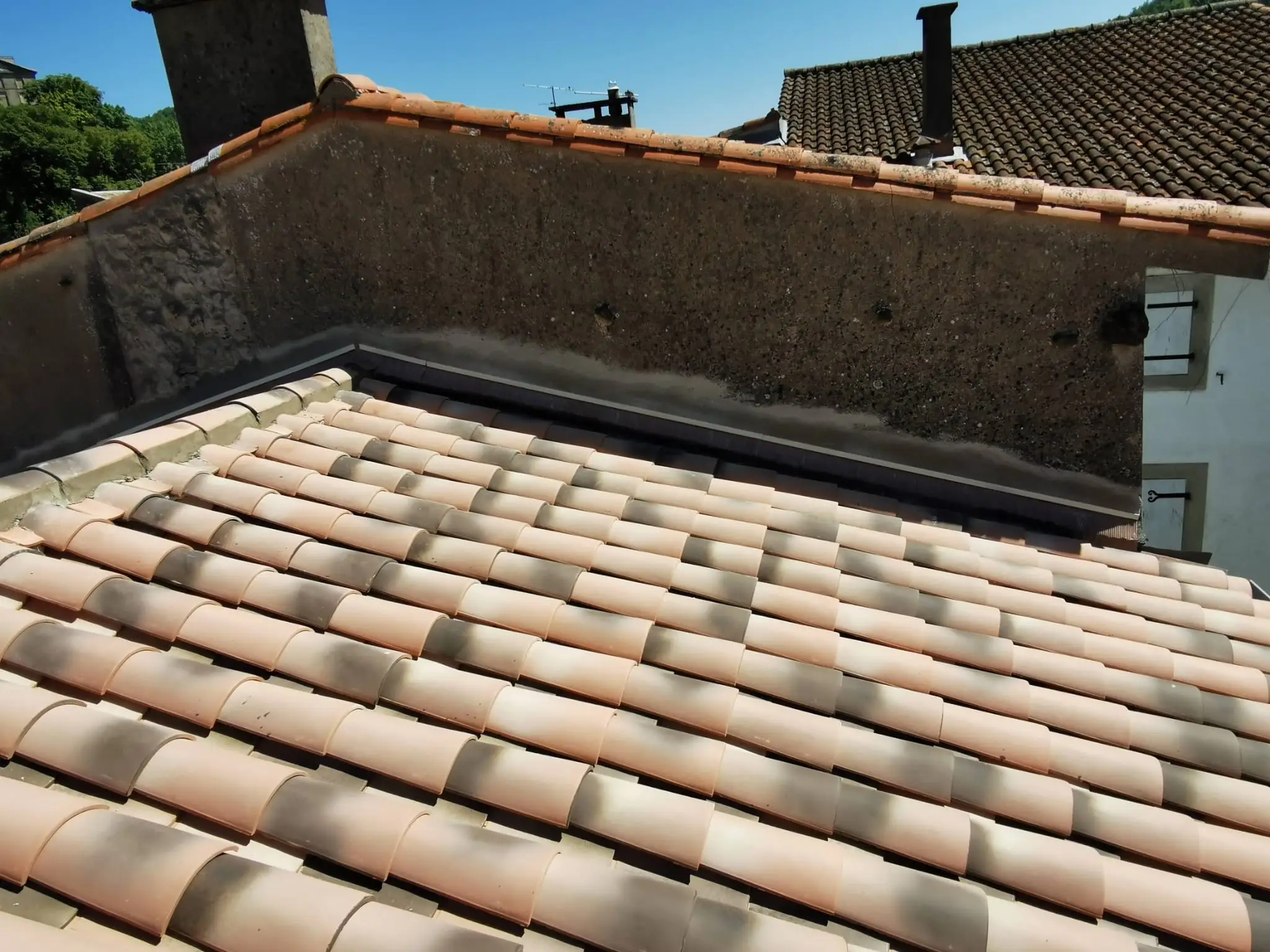
Where ridge tiles are bedded in mortar, they work loose one after another as the mortar moves and cracks. Wind then gets under the ridge line and drives rain back up against the fall, at exactly the point where the covering has no lap left to stop it.
Ridges, verges and flashing -
Chimney flashing — the “solin”
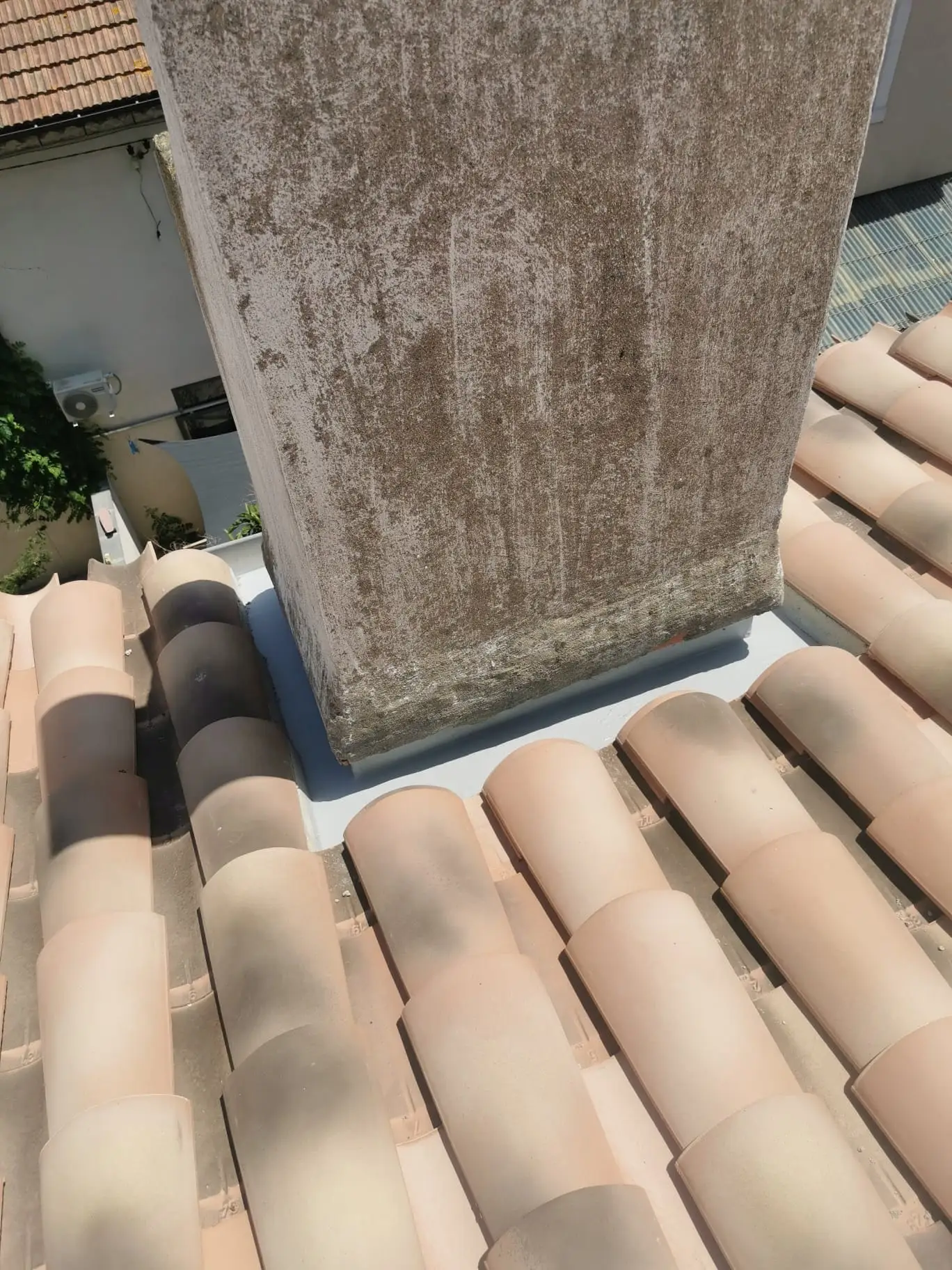
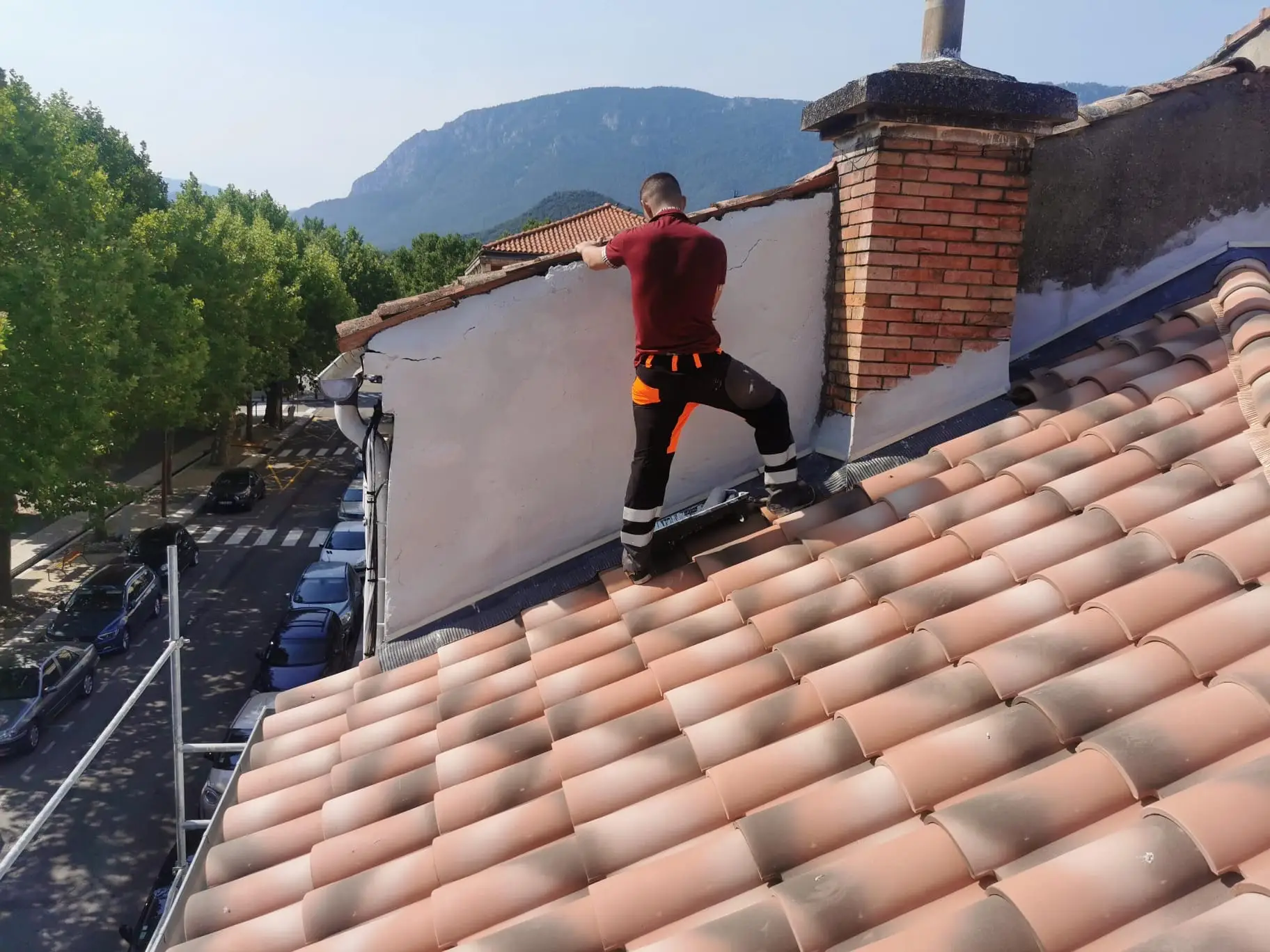
The join between masonry and tiles never stops moving: the stack and the roof structure do not shift together. Mortar flashing eventually cracks, and water runs down the side of the stack straight into the roof space. On older French properties this is one of the commonest ways in.
Chimney flashing -
A slipped, displaced or broken tile
The most frequent cause, and the simplest to put right. A cover tile moved by a few centimetres is enough: it no longer laps the tile beneath, and water goes straight onto the deck. Wind, a branch, or someone working on an aerial will do it.
Roof repairs and tile replacement -
The valley — the “noue”
Everything falling on two slopes passes through one detail, halfway down the pitch. A valley choked with leaves, too narrow, or with upstands that are too shallow spills sideways under the neighbouring tiles — and the leak then shows up well away from the valley itself.
-
The verge — the “rive”
The verge is the leading edge as far as the wind is concerned. Under the Cers these are the first tiles to lift and the first mortar to split. Once a verge is open, wind gets under the whole course, and every episode makes it worse.
Verges and closures -
Guttering and box gutters that overflow
A blocked outlet does not just spill down the outside. Water backs up behind the gutter, gets in at the foot of the covering and attacks the fascia and the ends of the boarding. A great many so-called roof leaks are really rainwater goods that have stopped coping.
Zinc work and guttering -
Underlay that is torn — or was never there
Many older roofs have no underlay at all, so nothing stops water that gets past the tiles. Where there is one, a tear or a badly lapped joint turns the second line of defence into a collector: it guides the water to the nearest low point instead of carrying it down to the eaves.
Re-roofing and underlay
When several of these have failed at once, leak detection usually concludes that the covering has reached the end of its life rather than that one thing has gone wrong.
In the meantime
What you can do in the meantime
None of this repairs a roof. All of it limits the damage and makes the diagnosis faster once someone is there.
-
Catch the water — do not block it
A bucket and a sheet under the drip are worth far more than an improvised seal. Blocked water does not go away; it finds another way out, usually further off and more expensive. If the ceiling is bulging, a small hole at the lowest point lets it drain where you expect rather than bringing the whole board down.
-
Photograph it, and note when
A photograph taken during the event, with its date, ties the leak to a particular kind of rain or wind. Knowing that it only appears in a westerly, or only in violent storms, narrows the search immediately.
-
Clear the space underneath
Moving whatever is stored under the mark prevents a second lot of damage, and leaves the route visible on the boarding. If the roof space can be reached safely, a fresh trace on the timber is worth any amount of description.
-
Stay off the roof
A wet tile gives no warning, and an old covering cannot be walked on just anywhere — the boarding can give way with nothing to announce it. It is the most tempting thing to do, and the surest way to turn a leak into an accident.
A leaking roof is better dealt with by phone than in writing.
What people assume about a leak
- What people assume It leaks, so there is a hole.
- What actually happens Almost never. In the vast majority of cases there is no hole at all: there is insufficient headlap, a loose flashing, a choked valley, or a tile shifted by two centimetres. Looking for a hole means missing the actual fault.
- What people assume It only leaks in a gale, so it is not serious.
- What actually happens On the contrary, that is valuable information: a leak that only shows in a westerly identifies an exposure, and therefore one side of the house. Note the wind — it halves the search.
- What people assume A bit of mastic will do for now.
- What actually happens Mastic on a roof is almost always the mark of an emergency repair that failed. It lasts a winter, hides the real fault, and complicates the proper fix. An honest tarpaulin beats invisible mastic.
What to note before you call
- Exactly where Room, wall or middle of the ceiling, and how far from a chimney or a party wall. A photograph of the ceiling is enough.
- After what kind of rain A short shower, long rain, rain with wind. Those are three different mechanisms and three different places to look.
- Since when, and whether it is growing An old ring that no longer moves is not the same urgency as a mark that spreads with every episode.
- What you can hear Running water in a loft is located far better by ear than by eye. Go up with the light off, on a wet day.
How a leak is traced
- We start from the stain, not the roof From inside first: the mark, the timber above it, and which way the water ran across the loft floor.
- We follow the path back Along the rafter, up to the highest point where the timber is still marked. That is where it gets in, or very near it.
- We check the three usual suspects Chimney flashing, valley, wall abutment. Statistically most roof leaks are there — never in the middle of a slope.
- We open up to be sure A few tiles either side. A flashing is judged from underneath: from the street a failing junction and a sound one look identical.
- We water-test if needed In sections, working upwards, watching from the loft. It is slow, and it is what gives certainty.
On site
The same ways in, photographed
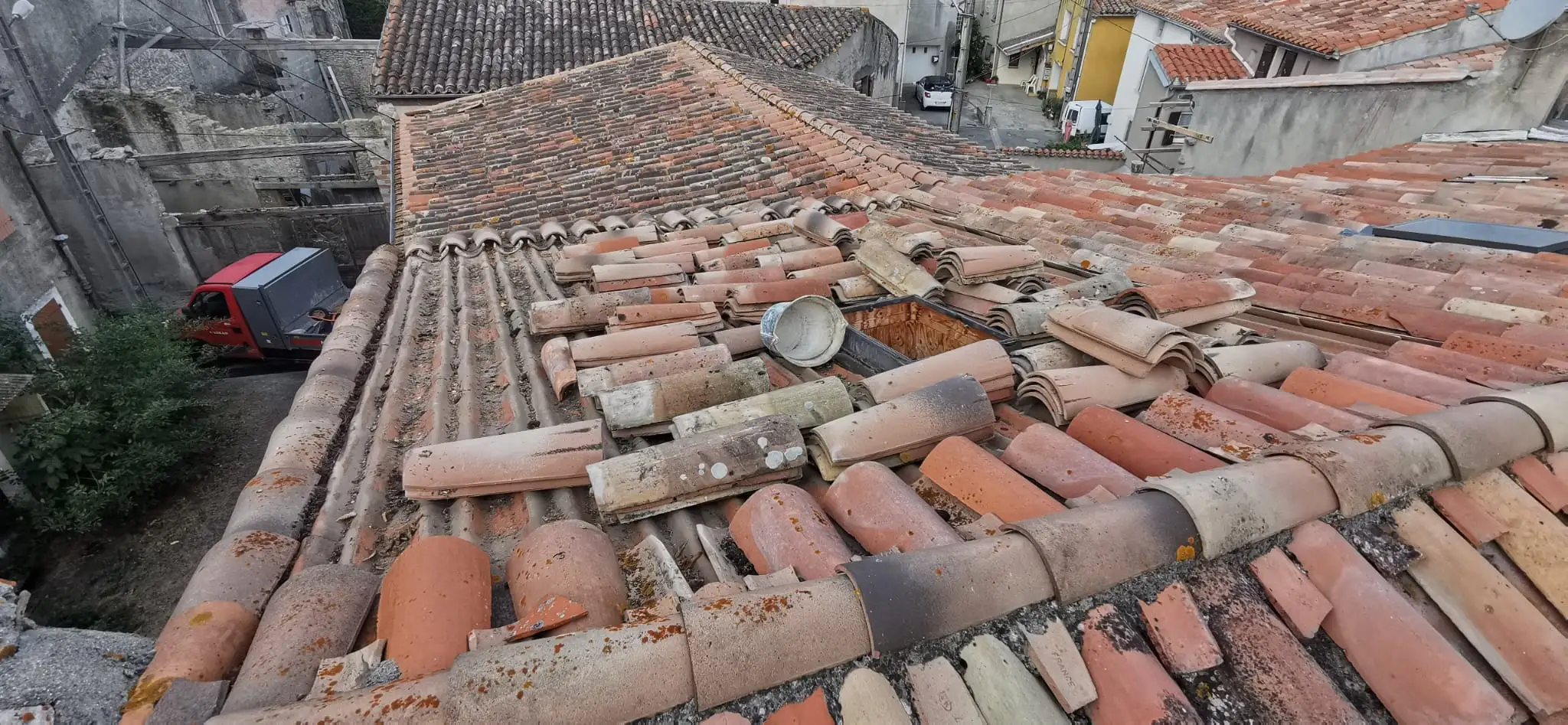
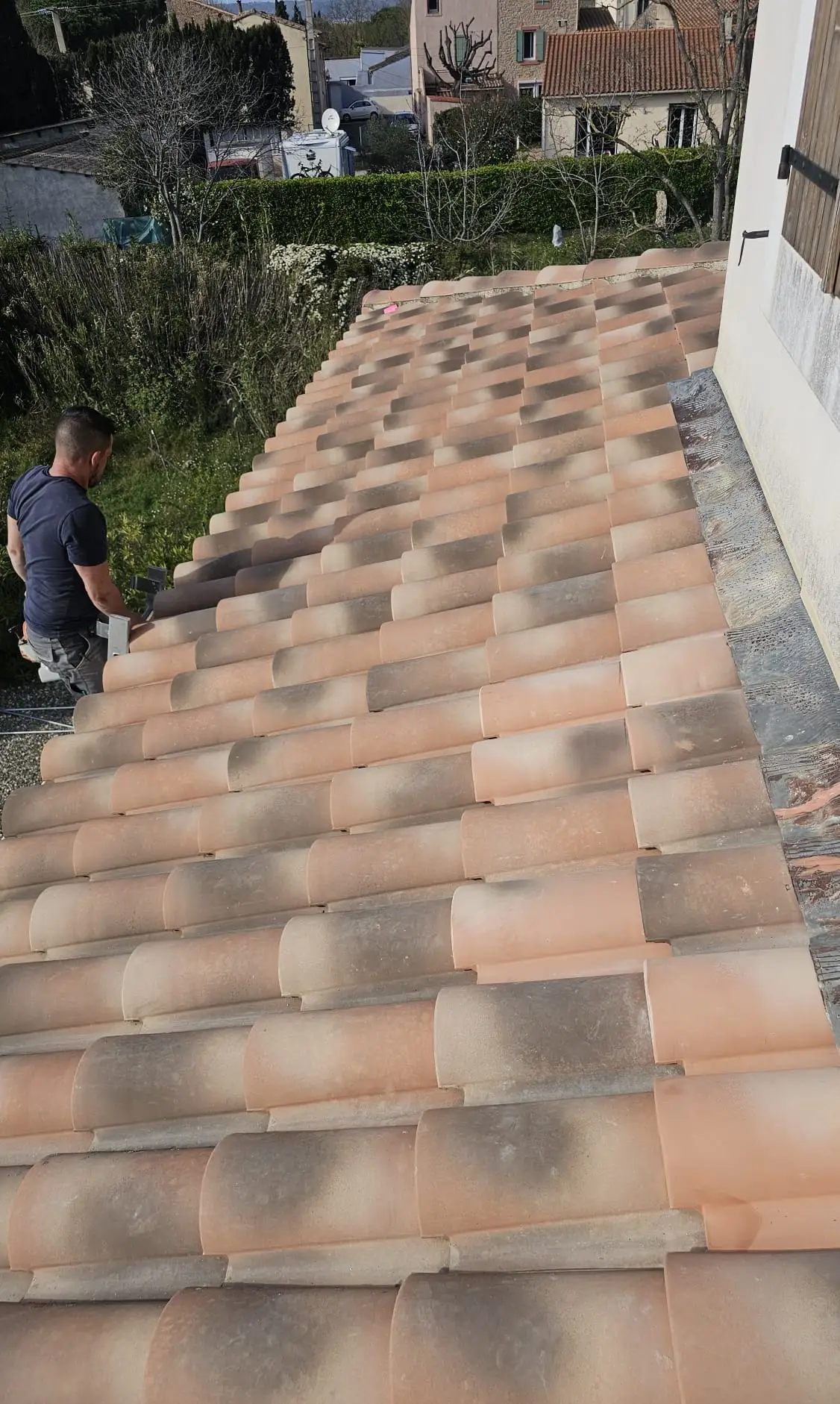
The drawing locates them; the photographs show them. All MBS Roofing Work South France sites — the details where most leaks start, once they have been rebuilt.
The services that deal with the cause
- Roof repairs and tile replacement When the leak comes from a slipped or broken tile, the repair is contained and quick — the best case there is.
- Ridges, verges and chimney flashing These details account for most leaks on a tiled roof. It is where the majority of them are actually resolved.
- Zinc work, guttering and box gutters An overflowing gutter causes damage that is taken for a roof leak almost every time.
Where we work
A leak has to be dealt with where it is, so having a roofer nearby matters more for this than for anything else we do. Our four areas cover the Haute-Vallée de l’Aude, the Minervois and the Alaric, the Corbières, and the Montagne Noire and Cabardès.
Minervois & Alaric Haute-Vallée de l’Aude Corbières Montagne Noire & Cabardès
Common questions
I don’t speak French. How do I describe a leak?
In English — that is rather the point. If you would like the French terms anyway, they are the ones used on this page: a leak is “une fuite”, water getting in is “une infiltration”, the flashing round a chimney is “le solin”, the ridge is “le faîtage”, a valley is “une noue”, the verge is “la rive”, and the underlay is “l’écran de sous-toiture”. They will all appear on any quotation you are given.
How is a roof leak actually traced?
From the evidence, never from a guess. We find exactly where the water shows inside, go up into the roof space to follow the trace along the boarding or the underlay, then look outside for the fault at the top of that route. The way in is almost always higher than the way out, and rarely directly above it.
Should I wait until it dries out before calling?
No — the opposite. A fresh trace is far easier to read than a dry ring: it shows the route the water actually took, whereas an old stain only shows where it left. If you can photograph it while it is happening, do.
Can it be repaired without redoing the whole roof?
Usually, yes. A leak is a contained problem and is treated as one: re-forming a flashing, replacing a few tiles, re-bedding a ridge, clearing a gutter. Re-roofing only enters the conversation if the search shows that the deck or the covering as a whole has had enough.
The house is empty for months at a time. What then?
A leak in an unoccupied house is nearly always found too late — the ceiling has already moved and the insulation is saturated. If a neighbour tells you there is a mark, a check is worth more than waiting: the cost of an infiltration grows with how long it lasts, not with how big it looks.
Will my insurance cover it?
That depends on your policy and on what caused it: water getting in through a worn covering and damage caused by a storm are not treated under the same cover. Either way, knowing precisely where the water came in and what failed is where any claim starts.
Tell us what you can see
For a leak that is happening now, the phone is quickest. If you would rather write, say where the mark is, when it appears, and what you can see in the roof space — that is most of what is needed. Write in English; that is entirely fine.