
Area 03
Roofer in the Corbières
Garrigue, limestone and villages of real character. This is the area where what is already there matters as much as what you come to do.
The Corbières are a massif, not a plain: dry relief, garrigue, villages clinging to slopes or tucked into the bottom of valleys. Limestone is everywhere — in the ground, in the walls, and in the light.
It is also the area where the old building stock is best preserved and most closely watched. Lagrasse is one of the “Plus Beaux Villages de France”, and heritage constraints here are real. On an old canal-tiled roof they are not a nuisance: they pull in the same direction as common sense.
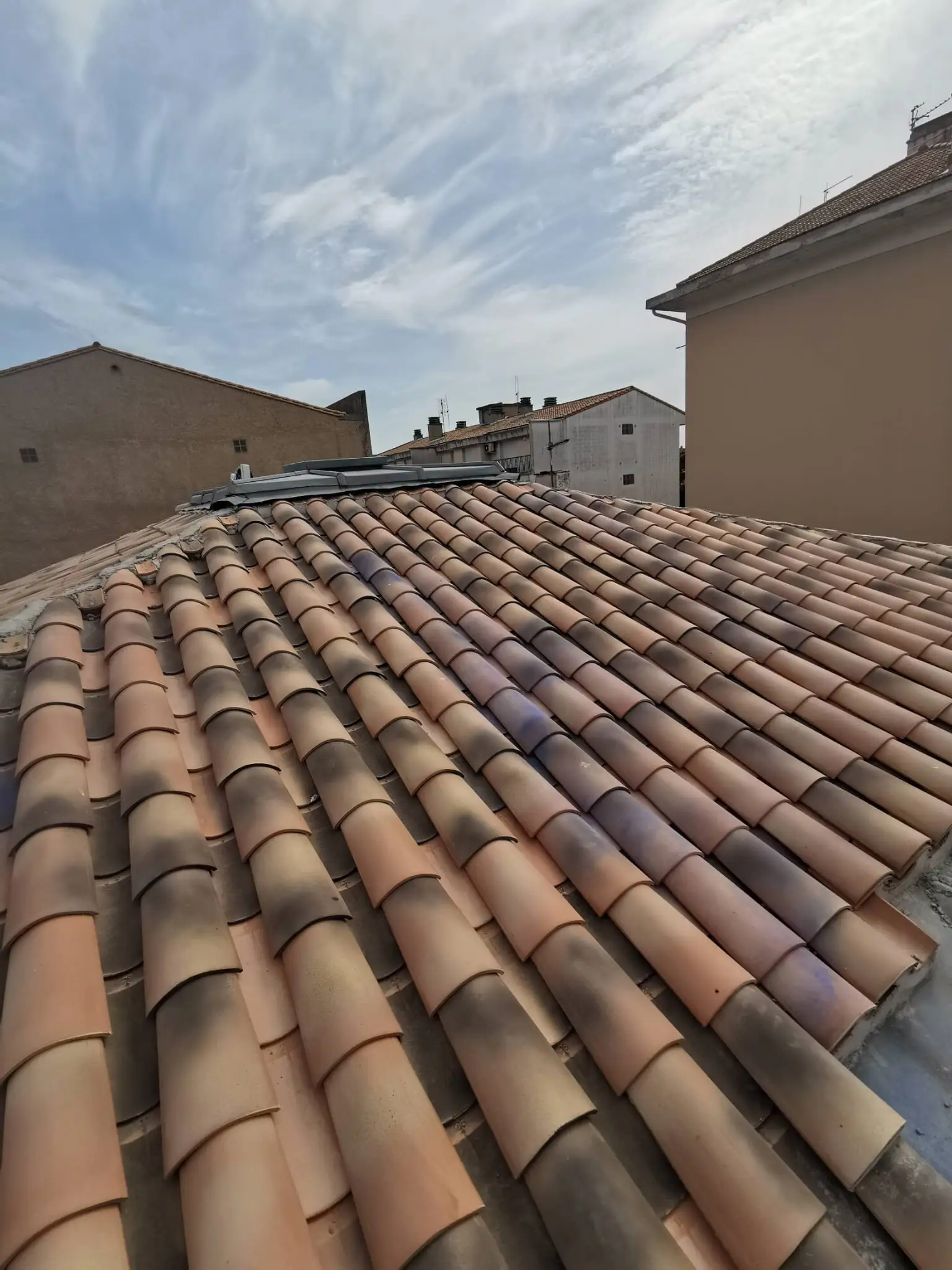
The ground
What the massif does to roofs
Three characteristics of this landscape, and what each one does to a tiled covering.
-
Respecting what is there is not optional
In a protected village, the shade and curve of the tiles, the treatment of the ridge and the appearance of the verges may all be regulated. That makes reusing the original tiles genuinely valuable — and sorting them as the roof comes off far more than a detail.
-
Dry, then brutal
The garrigue lives with long droughts and Mediterranean storms that drop a month of rain in a few hours. Mortars crack with the swing, and valleys and box gutters fill on the first heavy downpour.
-
Access has to be earned
Villages on slopes, lanes, small squares: access shapes the job as much as the roof does. A pallet delivery or a scaffold erection is planned, not improvised the night before.
What an old roof suggests, and what is found on it
- What people assume Mismatched tiles mean sloppy work.
- What actually happens Usually the opposite. A roof repaired with reclaimed tiles, matched to what is already there, takes sorting and time. It is the entirely new, uniform, patina-free covering that gives away the quick answer on an old building.
- What people assume An old roof has to be completely redone.
- What actually happens Rarely. What fails on an old roof is the awkward parts — verges, ridge, chimney junctions — plus the deck under wherever it has leaked. The rest of the slope is often sound, and stripping it would throw away irreplaceable tiles.
What to look at on a Corbières village house
- The ridge, from the street Bedded in mortar on most old houses. Crumbling mortar shows from a distance and is repaired before it gets expensive.
- Verges on the gable wall Very exposed to wind. A loose verge tile is the single most common starting point for trouble.
- The génoise The corbelled tile cornice at the top of the wall. If it works loose, it is the top of the wall taking water, not just the roof.
- The tiles on the north side Thick moss and flaking tiles: it is the slope that ages first, and the one nobody looks at.
What we look at on arrival
- Surveying the generations of tile We count what is in place, type by type, and what can be reused. That survey decides everything else, including lead times on supply.
- Stripping a test area A few square metres only, at the most suspect point. It is the only way to know whether the deck holds without committing to a full strip.
- Sounding the génoise From the scaffold, tile by tile. A course that moves by hand means dead bedding, invisible from the ground.
- Checking the bedding right through We open the ridge mortar over a short length. Bedding can be intact on the surface and powder inside.
- Working out the access Street, skip position, lifting point. In a perched village that governs the timetable as much as the work itself.
Where it sits
The area, within the territory
The relative position of the four areas. The others are clickable — it is often the neighbouring one you were after.
Positions to scale · areas approximate · rings at 10, 20 and 30 km from Carcassonne.
- Minervois & Alaric The area MBS Roofing Work South France works from, running from the Aude plain to the lower slopes of the Alaric, and across into three villages in the Hérault.
- Haute-Vallée de l’Aude From Limoux up through the gorges towards Quillan — a valley of stone villages where roofs take a beating.
- Corbières Villages of real character with old roofs, where renovation has to respect what is already there.
- Montagne Noire & Cabardès Higher, wetter and more exposed — roofs age differently up here than they do down on the plain.
Villages and towns covered in this area
- Bizanet
- Saint-André-de-Roquelongue
- Montredon-des-Corbières
- Fabrezan
- Névian
- Ferrals-les-Corbières
- Luc-sur-Orbieu
- Ornaisons
- Saint-Laurent-de-la-Cabrerisse
- Boutenac
- Val-de-Dagne
- Moux
- Montséret
- Fontcouverte
- Thézan-des-Corbières
- Lagrasse
- Talairan
- Camplong-d'Aude
- Tournissan
- Ribaute
- Serviès-en-Val
- Saint-Pierre-des-Champs
- Villerouge-Termenès
- Fontjoncouse
- Coustouge
- Taurize
- Vignevieille
- Labastide-en-Val
Show the other 9 villages in this areaCollapse the list
- Albas
- Rieux-en-Val
- Arquettes-en-Val
- Caunettes-en-Val
- Termes
- Jonquières
- Mayronnes
- Villetritouls
- Saint-Martin-des-Puits
Services
What we do in the Corbières
All six services. Here, reusing original tiles and rebuilding the critical details carry particular weight.
What we cover
An area shared with the Minervois
Lézignan-Corbières sits in the Minervois & Alaric area in our division, because a village can only have one primary listing. It obviously belongs to both worlds, and that changes nothing about how we work there.
The massif takes longer to cross than the plain. That is the only reason we do not claim to cover the whole of the Corbières — only the villages we actually serve.
Common questions about this area
Are there particular constraints in a protected village?
Often, yes. Depending on the village and the area concerned, the appearance of the covering can be regulated: tile colour, type of ridge, treatment of the verges. It is checked at the mairie before anything is ordered — and in practice it argues strongly for reusing the tiles already on the roof.
Can the tiles from an old roof be reused?
Very often, and this is where it matters most. A sound old canal tile has already proved itself, and gives the finished roof a patina new tiles cannot imitate. Sorting happens as the covering comes off, tile by tile.
Do you cover every village in the Corbières?
No, and we would rather write that down. The massif is large and slow to cross. We cover Fabrezan, Lagrasse, Saint-Laurent-de-la-Cabrerisse and Boutenac, as well as Lézignan-Corbières. For a neighbouring village, the simplest thing is to ask.
A roof in the Corbières?
Tell us the village and the state of the covering. If the building is old, say so: it changes what we will suggest.